
TL;DR
- What it is: BuzzSumo is a content research and social analytics platform owned by Cision, built for marketers, PR teams, and SEOs who want to see what content is winning and who is amplifying it.
- Pricing (2026): Three self-serve plans. Content Creation at $199/mo, PR & Comms at $299/mo, and Suite at $499/mo. A custom Enterprise tier exists, and a 30-day free trial has replaced the old free plan.
- G2 rating: 4.5 / 5 across 106 verified reviews.
- Best for: In-house content teams, PR pros, and mid-sized agencies who need trend discovery, competitor content teardowns, and journalist or influencer outreach in one place.
- Skip it if: You're a solo creator, a bootstrapped startup, or you mostly need scheduling, publishing, or hardcore SEO features. Ahrefs, Semrush, and Sprout Social will serve you better in those lanes.
- Verdict: BuzzSumo is still the sharpest tool for "what content is working right now?" The price puts it firmly in the "team purchase" bucket in 2026.
What Is BuzzSumo?
BuzzSumo is a content intelligence platform that indexes billions of articles and social posts, then lets you slice that data by topic, domain, author, network, engagement, and backlinks. It was founded in 2013, acquired by Brandwatch, and now sits under the Cision umbrella. That's why you'll see "By Cision" on its G2 listing today.
The pitch is simple. Instead of guessing what to publish, you look at what's actually earning shares, backlinks, and comments in your niche, then reverse-engineer the format, angle, and headline. It's the tool most editorial teams open first thing on a Monday.
For a wider view of where BuzzSumo sits in a modern stack, see our list of the 54 best marketing tools and 21 digital marketing tools for 2026.
What's New in BuzzSumo for 2026
A few things worth flagging since older reviews were written:
- The free plan is gone. New users now get a 30-day free trial instead of the old freemium tier, which changes the "try before you buy" calculus for solo marketers. After the trial, you need a paid subscription starting at $199/month.
- Cision integration. Since the acquisition, BuzzSumo now pairs more tightly with Cision's PR database, which is most visible on the PR & Comms plan (journalist search, media contact lists, and pitch-tracking).
- AI-assisted features. BuzzSumo has been layering AI into content ideation and PR pitching. Reviewers describe an AI pitching tool and smarter alert filtering as recent additions. Its AI pitching tool and customizable alerts enhance the efficiency of outreach efforts.
- Index scale. BuzzSumo's index is now cited at 8+ billion articles across the web and social platforms, up from earlier "5 billion" claims in older reviews.
Core Features (and What They're Actually Good For)
1. Content Analyzer
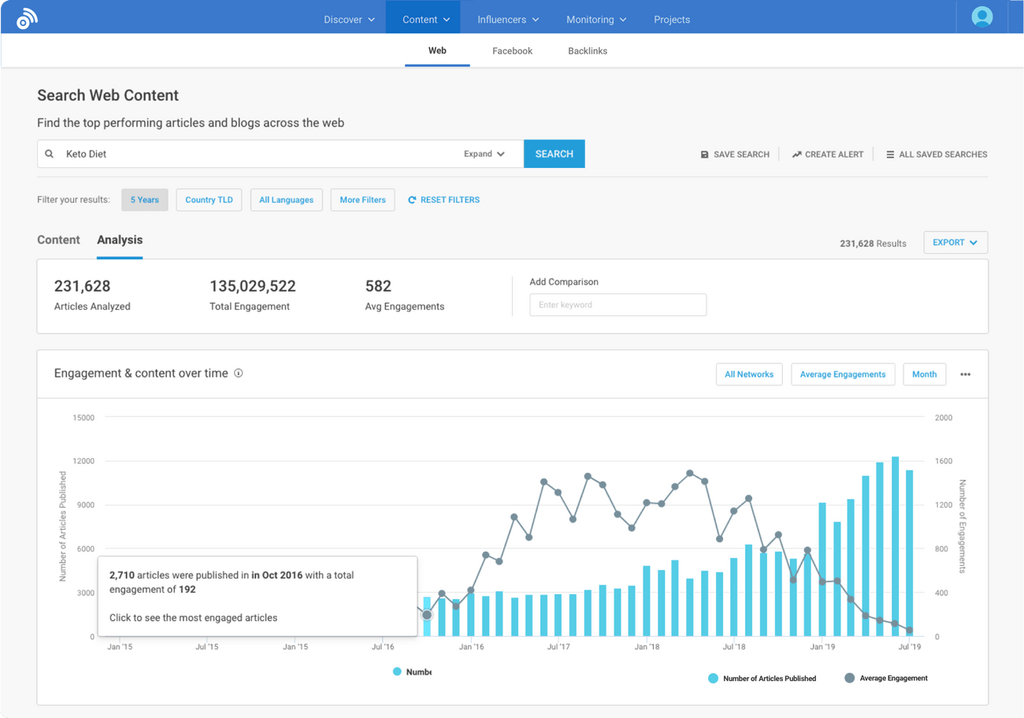
The signature feature. Type a keyword, phrase, domain, or URL and get a ranked feed of the top-performing pieces of content across Facebook, X (Twitter), Reddit, Pinterest, and general web engagement, plus backlink counts and evergreen scores.
Use case: You're planning next quarter's editorial calendar for a fintech blog. Search "buy now pay later" for the last 12 months, filter by article type, and you'll see which headlines and angles have earned the most engagement and links. Copy the winning formats, not the losing ones.
2. Trending Feeds
A real-time feed of trending stories, filterable by topic, geography, and time window. Reviewers say this is where BuzzSumo pulls ahead of general SEO tools. The alert feature is particularly valued for fast notifications that enable marketers to react quickly to new trends or emerging topics
Use case: Newsroom teams and SaaS content editors use it as a morning briefing to spot stories worth commenting on before the news cycle moves.
3. Influencer Research
Search by topic or domain to surface the writers, creators, and social accounts with the strongest engagement in that space. You can filter by audience size, engagement rate, network, and location, which is useful for outreach lists, guest post targeting, and paid partnerships. If influencer discovery is your main use case, also compare against our roundup of the 14 best influencer marketing tools. BuzzSumo is one of several serious options.
4. Question Analyzer
Pulls the actual questions people are asking on forums, Q&A sites, and Amazon reviews around a keyword. This is arguably the most underused feature. It's a shortcut to "People Also Ask" style content that maps directly to search intent and to how large language models pull citations. Pair it with our guide on Instagram influencer marketing strategies or influencer marketing's role in SEO when planning topic clusters.
5. Content Alerts and Brand Monitoring
Set alerts for your brand, competitors, specific keywords, authors, or backlinks. New mentions land in your inbox or Slack. Reviewers consistently rate this a top-three feature. The software scours the internet and alerts you anytime your keyword is mentioned on a website, blog, social media, and so on.
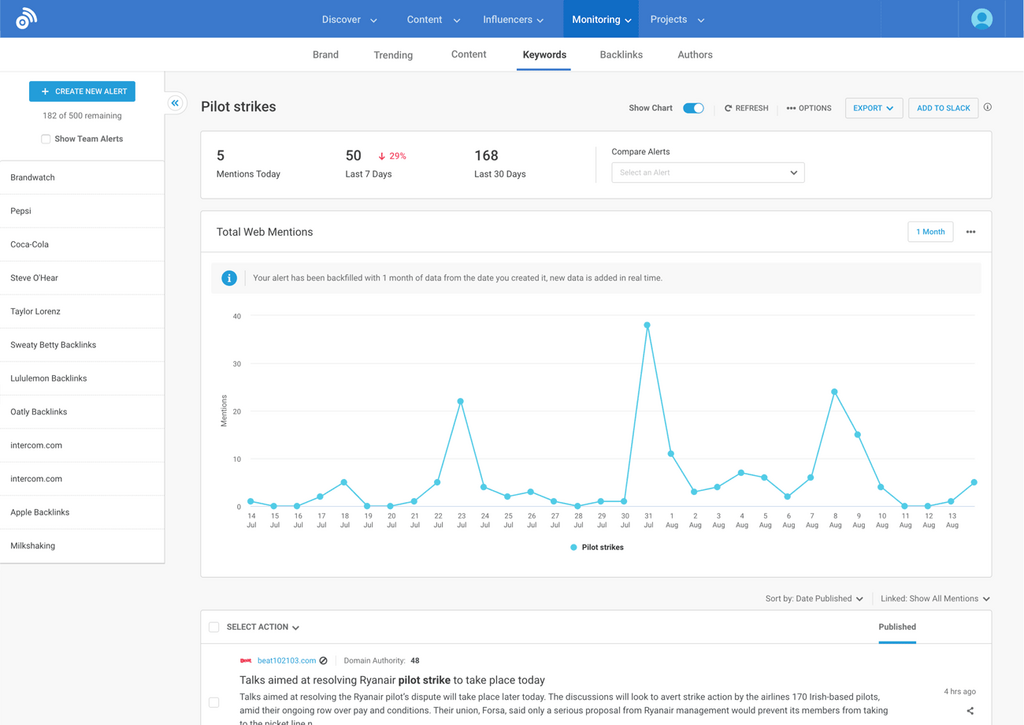
One caveat worth knowing. BuzzSumo does not provide real-time brand mention tracking; it offers content alerts that notify users of new articles and mentions based on specified keywords. If you need instant social listening, you'll still want a dedicated tool alongside it.
6. Domain Comparison and Competitor Teardown
Enter up to four domains and see side-by-side which is winning more shares, which topics each is ranking for, and where the content gaps are. This is the feature agencies use in new-business pitches. The visualization makes competitive gaps easy to explain to a non-marketer.
7. Facebook Page Analyzer
Benchmark any public Facebook page against competitors by engagement, post type, and day of week. It's more useful than it sounds if you're planning organic Meta content.
8. API and Chrome Extension
The API lets you pipe BuzzSumo data into your own dashboards, and the Chrome extension gives you engagement stats on any URL you land on. Both are quality-of-life features that add up over months of use.
Real Use Cases: Who Actually Wins With BuzzSumo?
Content marketers planning editorial calendars. You can build a whole quarter's content plan from Content Analyzer plus Question Analyzer output in a single afternoon. For a bigger view of how AI is reshaping this workflow, see our take on the future of content marketing with machine learning and AI.
PR and comms teams on the PR & Comms plan. Journalist search, media outreach tracking, and coverage monitoring in one place, without a separate Cision seat.
SEO teams doing backlink prospecting. The backlink data plus influencer discovery is a decent link-building shortlist generator. If you're mostly here for SEO, though, cross-check with our guide to the best SEO tools before committing.
Agencies running client reports. The exportable dashboards, competitor comparisons, and share-of-voice data ship well in monthly decks.
Solo creators and small blogs. This is where BuzzSumo struggles to justify itself. The Content Creation plan is $199/month, and much of what a solo creator needs (topic ideas, trending stories) is achievable with a mix of Google Trends, Answer The Public, and free social listening. This trade-off is the same one flagged in our older piece on alternatives to BuzzSumo. It's still true in 2026.
BuzzSumo Pricing in 2026
BuzzSumo publishes four tiers on its pricing page. As of mid-2026:
Pricing verified against G2's product listing and Capterra's software profile: BuzzSumo starts at $199/month for the Content Creation plan, with PR & Comms at 299 and Suite at 499.
What changed: The old $99 Pro tier that appeared in older reviews (and still shows up in some 2026 blog posts) is no longer the entry point on BuzzSumo's official pricing page. Any "Pro at $99" mention you see is out of date.
Free trial: 30 days, no credit card at signup for most users. There is no permanent free plan anymore.
Total cost of ownership: One pricing analyst estimated the 3-year TCO on the Suite plan at roughly $17,964. The industry average for similar tools is $15,000, and BuzzSumo's higher TCO reflects its premium feature set.
What Users Actually Say on G2 (Real Reviews, Not Marketing Copy)
BuzzSumo carries a 4.5 out of 5 average across 106 verified reviews on G2, with the majority of reviewers from small-business segments.
The praise clusters around four things:
- Content discovery speed. Reviewers repeatedly cite the Content Analyzer and Trending Feeds as time-savers that replace hours of manual research. On the G2 listing, one reviewer's summary (paraphrased) is that BuzzSumo saves hours of research and helps plan content more likely to succeed.
- Backlink and competitor analysis. A content writer's review on G2 highlighted backlink analysis by keyword as the standout feature for understanding competition and shaping strategy. (Source: G2 review by Zahabiya K.)
- Alerts and brand monitoring. Multiple reviewers name the alert system as their most-used feature. Brand mentions, competitor coverage, and keyword tracking all in one inbox.
- Ease of use. BuzzSumo scores 9.0 for ease of use and 9.1 for ease of setup on G2, which is notably higher than Sprout Social and CisionOne in the same category.
The complaints cluster around three things:
- Price. This is the number-one gripe, in almost every review. One G2 reviewer summed it up in a line (paraphrased) that at $249/month, it's not affordable for small businesses. The pricing objection shows up on Capterra too: "a little bit pricey for small businesses and solo site entrepreneurs but great value for agencies and larger businesses.
- Paywalled features. Reviewers on the Content Creation plan feel gated: the basic plan's restrictions turn BuzzSumo into purely a content inspiration tool, with search opportunities and trend analysis locked behind higher tiers.
- Report customizability. BuzzSumo scores just 6.7 on report customizability in G2's feature breakdown. That's noticeably lower than its own strong points and a real limitation if you need branded, white-label client reports.
A useful sanity check: on the Autoposting.ai long-form review, a marketer who used BuzzSumo for six months landed on a nuanced take. BuzzSumo is genuinely good at content discovery, it's expensive for what it is, and for a growing number of use cases there are better options. That matches what you see across G2 and Capterra when you read past the star ratings.
Pros and Cons
Pros
- Best-in-class content discovery and trending topics
- Massive index (8+ billion articles) with deep filtering
- Strong influencer and author search
- Question Analyzer is genuinely useful for content ideation and answer engine optimization
- Clean, intuitive interface with minimal onboarding
- Solid alert system for brand and competitor monitoring
- Chrome extension and public API
- Journalist and media features on the PR & Comms plan (post-Cision integration)
Cons
- No free plan; entry price is $199/month
- Many high-value features gated behind Suite ($499/month)
- Report customizability is weak (6.7 on G2)
- Not a true real-time social listener
- Limited multilingual support versus enterprise alternatives
- Same-story repetition across outlets can pad results
- No publishing or scheduling; insight tool only, execution happens elsewhere
BuzzSumo vs Common Alternatives
Quick honest comparison, from a marketer's rather than a vendor's point of view:
- vs Semrush / Ahrefs. Semrush and Ahrefs beat BuzzSumo on keyword research, rank tracking, and technical SEO. BuzzSumo beats them on social engagement data, trending story discovery, and influencer search. Most content teams end up with one of each rather than choosing between them.
- vs Sprout Social. Different jobs. Sprout Social is a publishing and social management platform; BuzzSumo is a research tool. They complement more than compete.
- vs Meltwater / Cision. More overlap since the Cision acquisition. If you already have Cision, the PR & Comms plan may be redundant; if you don't, it's a cheaper way in.
- vs free tools (Google Trends, Answer The Public, Exploding Topics). Free tools handle 60 to 70 percent of what a solo blogger needs. BuzzSumo's advantage kicks in when you need historical data, competitor comparison, and influencer plus backlink data in one place.
For a fuller alternatives list, see our dedicated BuzzSumo alternatives roundup.
Who Should Buy BuzzSumo (and Who Shouldn't)
Buy it if you are:
- A content or brand team publishing 8+ pieces a month across formats
- A PR agency or in-house comms team that needs journalist outreach plus coverage tracking
- A B2B marketing team that needs to prove content ROI with hard engagement data
- An SEO or content hybrid at a mid-size company running competitor teardowns quarterly
Skip it if you are:
- A solo creator or hobby blogger. Google Trends plus Answer The Public will cover you.
- An early-stage startup with under $2K/month in marketing tool spend
- A team whose primary need is publishing and scheduling. Buy a social suite instead.
- A pure technical SEO shop. Ahrefs or Semrush will give you more value per dollar.
Verdict
BuzzSumo in 2026 is a mature, focused tool that hasn't tried to be everything. It does content research and discovery better than almost anything else, and the Cision integration has made the PR & Comms tier genuinely competitive. The trade-off is honest. It's expensive, it doesn't publish or schedule for you, and its report customization is behind the times.
If your team lives inside content strategy meetings, planning editorial calendars, running competitor teardowns, briefing writers, monitoring brand mentions, and pitching journalists, BuzzSumo will pay for itself. If your work sits anywhere else, spend the $199/month on the tool that fits that work instead.
Our rating: 4.3 / 5. Strong tool, priced for teams, not individuals.
FAQs
Q: Is there a free version of BuzzSumo in 2026?
A: No permanent free tier. BuzzSumo offers a 30-day free trial; paid plans start at $199/month.
Q: How much does BuzzSumo cost?
A: Content Creation is $199/month, PR & Comms is $299/month, and Suite is $499/month. Enterprise pricing is custom.
Q: Is BuzzSumo worth it for small businesses?
A: Only if content marketing is a core function and you publish regularly. Most small businesses and solo creators are better served by a mix of free tools plus a lighter-weight paid tool. See our alternatives list.
Q: What is BuzzSumo best used for?
A: Content discovery, competitor content analysis, influencer and journalist research, and brand or keyword monitoring.
Q: Who owns BuzzSumo?
A: BuzzSumo is part of Cision, following Cision's acquisition of Brandwatch (which had earlier acquired BuzzSumo).
Q: Does BuzzSumo do social media scheduling?
A: No. It's a research and monitoring tool, not a publishing platform. You'll need a separate scheduler like Buffer, Hootsuite, or Sprout Social.
Q: How is BuzzSumo different from Semrush or Ahrefs?
A: Semrush and Ahrefs are SEO-first platforms centered on keywords, rankings, and backlinks. BuzzSumo is content-first, centered on social engagement, trending stories, and influencer discovery. Most content teams use one of each.
Q: Does BuzzSumo have an AI feature?
A: Yes. Recent updates added an AI-assisted pitching tool for PR outreach and smarter alert filtering. AI content ideation is being rolled deeper into the platform through 2026.


![30 Free Stock Image Sites To Download Photos in 2026 [Updated]](https://storage.ghost.io/c/c0/f5/c0f5a5c9-a064-4d18-92d9-da80f23651ff/content/images/size/w1304/format/webp/2026/01/Free-Stock-Image-Sites-min.jpg)