Most SaaS marketers I know have sat through the same meeting this year. Someone senior asks whether we show up in ChatGPT, nobody knows, and the plan gains a line called AEO with no owner.
I'm George Fakorellis. I spent about eight years in SaaS and fintech growth, mostly in organic search, and now I build AI agents and automations for marketing and write about SEO, AEO, AI agents and AI growth on growthvibes.ai. My view: answer engine optimization is mostly SEO done properly, plus a short list of extra habits, and the order matters more than the label. Here's mine, for a SaaS site that already ranks in Google.
What actually changed: ten links vs a handful of sources
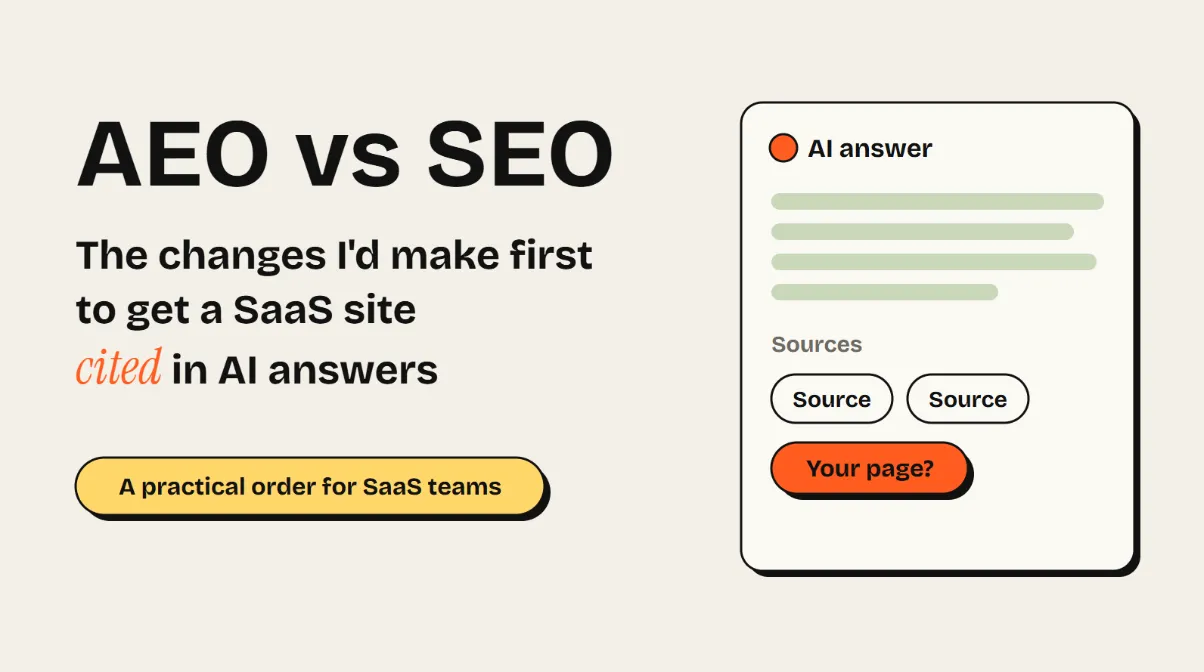
Google shows ten links and lets the searcher choose. An AI answer chooses first: it runs its own searches, reads a few pages, writes the reply and cites a handful of sources. Miss that shortlist and you aren't in the result at all, not even on page two, where results go to retire.
The questions changed too. Nobody asks ChatGPT for "email marketing software". They ask for "an email tool for a Shopify store that stays cheap past 10,000 subscribers", and the answer leans on pages that fit.
Underneath, Google says its AI features are rooted in its core ranking systems, plus query fan-out: the model fires off related searches and pulls pages from those too. In Minuttia and Convex Works' study of 18,084 software questions, only 21% to 28% of the pages cited by AI Overviews, Gemini, Perplexity and Claude also sat in Google's top 10.
So both camps are right, annoyingly. Ranking gets you into the room. The citation goes to the page that answers the follow-up questions the model asks for your buyer.
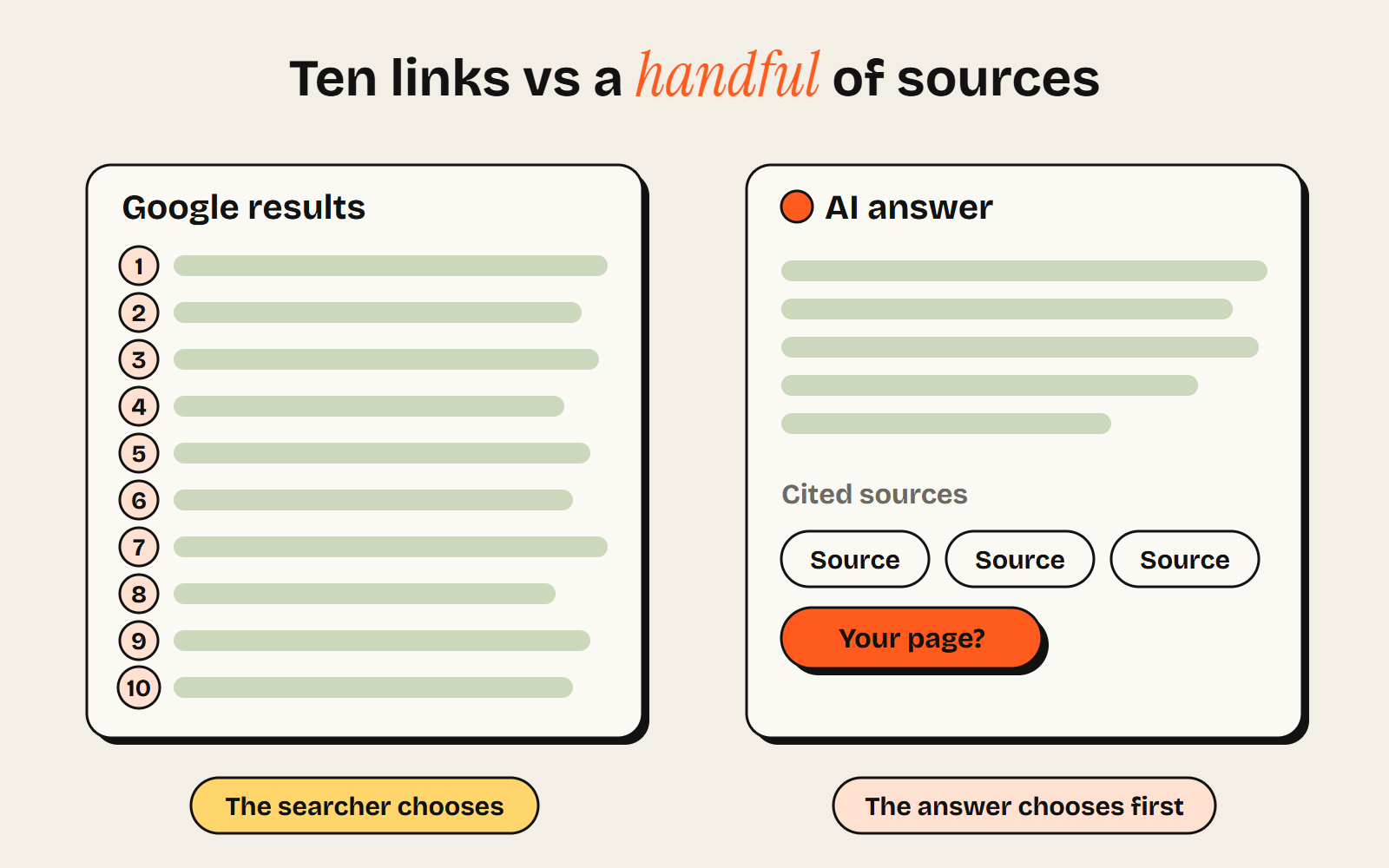
The searcher picks from ten links; an AI answer picks first.
How much traffic AI answers really send, and why that isn't the only number to watch
Very little, for most sites. In Marie Haynes' analysis of a year of GA4 data from 100 sites, published on 21 October 2026, ChatGPT sent 0.62% as many sessions as Google organic. All AI assistants together: 0.73%.
Compare that with OpenAI's remarks, published on 3 November 2026: ChatGPT handles about a fifth as many search-like queries as Google. A fifth of the questions, well under 1% of the clicks. People ask ChatGPT plenty. They just don't leave.
Even the trend is disputed. SE Ranking (101,574 sites, January to April 2026) has AI platforms growing from 0.24% to 0.32% of all website traffic; Haynes found ChatGPT referrals falling since August 2025. I wouldn't spend a meeting on the slope. Under 1% is under 1% either way.
It still isn't a rounding error, for two reasons.
First, conversion. In Haynes' data, ChatGPT visitors converted at 13.8% against 3.02% for Google organic. Google organic still drove 27 times as many conversions as all AI assistants combined. Math is still math.
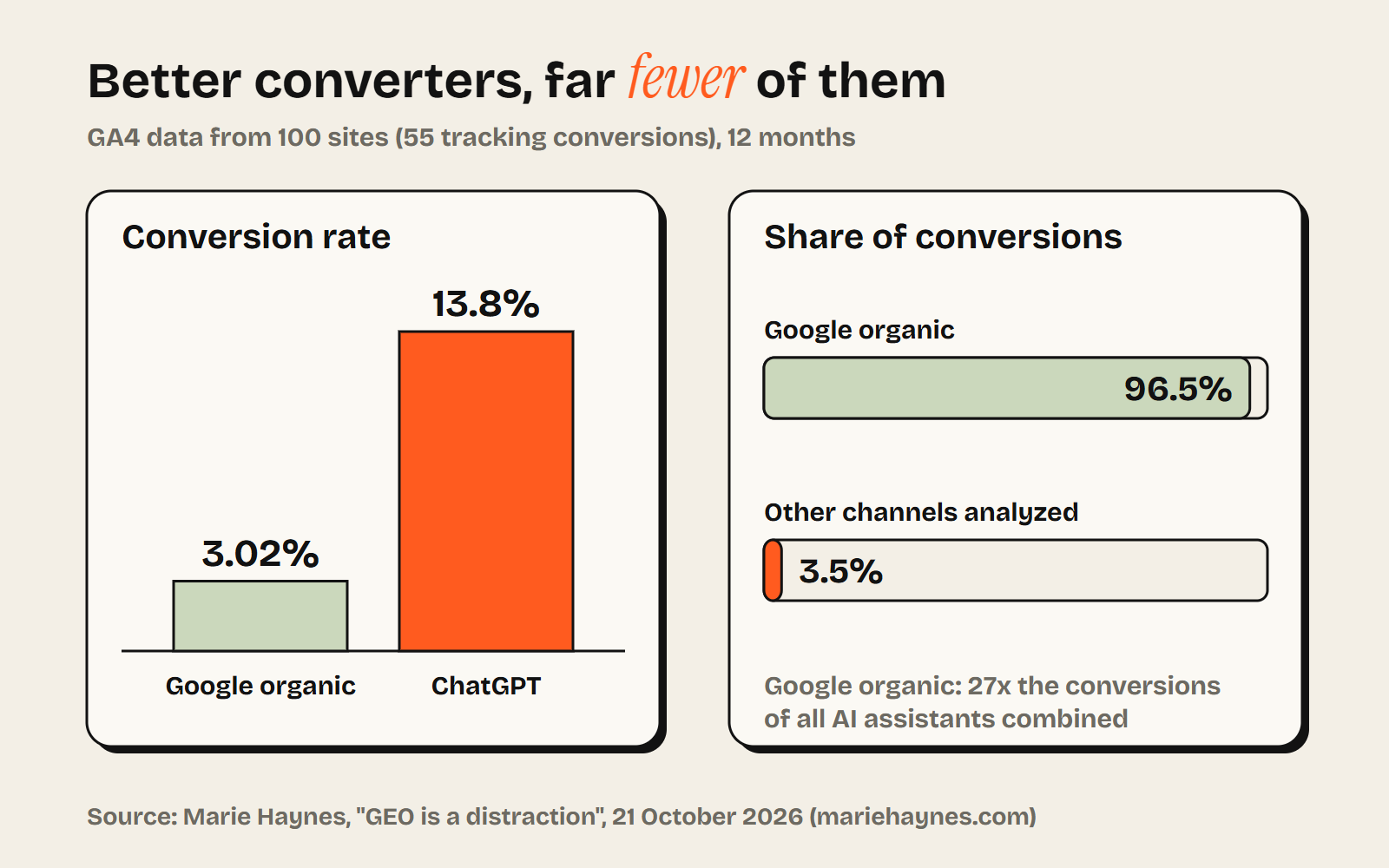
Data: Marie Haynes, GA4 data from 100 sites, 21 October 2026.
Second, influence that never becomes a click. A buyer gets three names from ChatGPT and a week later searches one of them. You'd hope to find that in Direct. Kevin Indig checked 12 sites in August and September 2026 and found Direct sessions with traceable AI fingerprints at 0.003% of Direct traffic. Analytics won't show it, so watch:
- Branded search impressions in Search Console.
- A "how did you hear about us" field at sign-up, with ChatGPT and "an AI assistant" as options.
Treat the AI referral line as a floor.
Check the basics first: can AI crawlers reach your pages at all
Before rewriting anything, make sure AI crawlers can fetch and read your pages, and that Google may use them in its AI features. It's the cheapest fix here and the easiest to botch.
Training and search crawlers are separate. From each company's docs, checked 14 November 2026:
Sources: each company's crawler documentation.
Block training bots if legal wants to. Block the search bots and you've opted out of citations, an odd move while funding an AEO project.
Google works differently. Since 31 August 2026 every site has a Search generative AI control in Search Console settings, which decides whether your content can appear in AI Overviews and AI Mode. Include is the default, but someone may have flipped it during a "block all the AI" week.
Then three quick checks:
- Read robots.txt for each search crawler above, including User-agent: * rules that catch them by accident.
- Check your CDN. Perplexity's docs note that Cloudflare's Bot Fight Mode can't be bypassed with custom WAF rules, so it can block crawlers your robots.txt welcomes.
- View the raw HTML of your pricing and comparison pages with JavaScript off. Vercel and MERJ found in 2024 that none of the major AI crawlers rendered JavaScript. If your pricing table loads client-side, those crawlers see an empty div with good intentions.
Pages that get cited: clear answers early, specific numbers, a page per question
For SaaS, the page that matters most is one you may already have: the comparison page.
At Moosend, the email marketing SaaS where I ran organic acquisition from 2018 to 2023, our first pillar was "Mailchimp alternatives". Mailchimp had high churn, so people searching that were ready to switch. We kept updating it, then built a cluster of alternatives and comparison pages around it. "Best X for Y" and "X alternatives" prompts draw on exactly that format, because a good comparison page has already done the shortlisting the model is trying to do.
Few AEO guides mention this part. In the Minuttia and Convex Works study, 34% to 47% of the listicles AI platforms cited were vendors' own "best tools" lists. 87% put the vendor first, and only 16% said who wrote them. So your comparison page is in the game. I'd still say you're the vendor and be fair to competitors. A list where you win every row is an ad with a table attached.
Then the habits that make any page easier to cite:
- Answer in the first sentence or two under each heading. If the answer sits in paragraph six, you're trusting the model to read that far.
- Use real, dated specifics: prices, plan limits, integrations. "Affordable" can't be quoted. A price can, and a stale one keeps getting quoted after you change it.
- Give each real question its own page. An integration buried as one bullet gives an answer nothing to cite.
- Publish data only you have. Competitors copied Moosend's, which was annoying and decent proof it was worth citing.
Mentions beyond your own site, and why they matter more for AI answers than for Google
An AI answer summarizes what the web says about you, and your site is one voice in it. Links did most of the off-site work in classic rankings; in AI answers, plain mentions on cited pages carry more weight.
Ahrefs' 2025 research found branded web mentions had the highest correlation (0.664) with a brand appearing in AI Overviews, ahead of branded anchors (0.527) and branded search volume (0.392). Correlation, not proof. The skeptic's view comes from Google: its guide says chasing inauthentic mentions isn't as helpful as it seems. Both point one way. Earn the mentions.
At Moosend we did this before AEO had a name. Our writers contributed to the HubSpot, Zapier and G2 blogs, and we partnered with the agency Digital Olympus on off-site authority. The goal was E-E-A-T and rankings. Those are the pages answer engines now read to decide who's credible in a category.
The recent version: at an AI video SaaS, I built an automated outreach workflow that found listicles in our niche (best video editors, AI video editors, AI avatar generators) and pitched each writer to include us, with a free account to test the product. An agency we directed was pitching listicle placements and guest posts too, so I won't take all the credit, but brand mentions went up in our AI visibility tracker, AirOps. Outreach is one of the marketing jobs an AI agent can already run, since most of it is finding and following up.
To start, pitch the publishers behind the listicles your buyer prompts already cite, with something usable: a free account, real pricing.
Measuring it: tracking whether ChatGPT, Perplexity and AI Overviews mention you
Pick about 20 prompts your buyers really use (from sales calls and support tickets), run them across ChatGPT, Perplexity and Google's AI Overviews every month, and log whether you're mentioned, whether you're cited, and who appears instead.
Answers change between runs, so one screenshot of ChatGPT recommending you proves only that someone in marketing took a screenshot. Track the share of prompts where you appear, month over month. A tracker like AirOps does it for you; a spreadsheet works if you're honest with it.
Then add what Google gives you free:
- Search Console's Generative AI performance report, for how your pages do in AI Overviews and AI Mode.
- AI Mode follow-ups in your queries. Search Console logs them as new searches, and GSC Wizard's study of 155 sites (14 October 2026) found replies like "yes please" on 94 of them. If you see those, it's a good sign AI Mode conversations reach your pages.
- A GA4 channel for AI referrers such as chatgpt.com, perplexity.ai and gemini.google.com.
I think one person with a few agents can now run most of a marketing function, and this is the first job I'd hand over.
The agent is small: it runs the same prompts every week, logs who got named and flags the weeks you drop out. Here's a step-by-step guide to building a small AI agent. Goodbye, most boring hour of the month.
What not to do: rewriting everything for AI and losing the Google traffic you have
Don't rewrite your best-ranking pages for AI. Google sends far more traffic than AI answers do, and its AI features run on the same index, so damage the rankings and you lose both at once.
Google's guide is blunt: no need to chunk content, rewrite it for AI or add llms.txt for its features. Stripping depth from pages that work, to look "extractable", is all risk. Add instead, in this order:
- Crawler access, rendering and the Search Console control.
- Direct answers under the headings of pages that already rank.
- The comparison and alternatives pages you're missing.
- Earned third-party mentions.
- Prompt tracking.
And ask whether you need it at all. At Wealthyhood, a B2C investing app where I was head of growth, there wasn't much search demand for what the app did, so search wasn't our main channel and AI visibility never got its own project. Right call. If buyers don't search for or ask about your category, AEO deserves an afternoon with robots.txt and not much more.
So, back to that meeting. The honest answer to "do we show up in ChatGPT?" is "here are 20 buyer prompts, here's where we appear, and here's the order we're fixing things in". Less exciting than a new line item, and it survives the next planning cycle, which most AEO line items won't.
The first change is still the boring one. Open robots.txt.
About the author
George Fakorellis builds AI agents and automations for marketing and AI growth at growthvibes.ai, and offers SEO and AEO services. Ex Moosend, Wealthyhood, Synthesia. LinkedIn