TL;DR
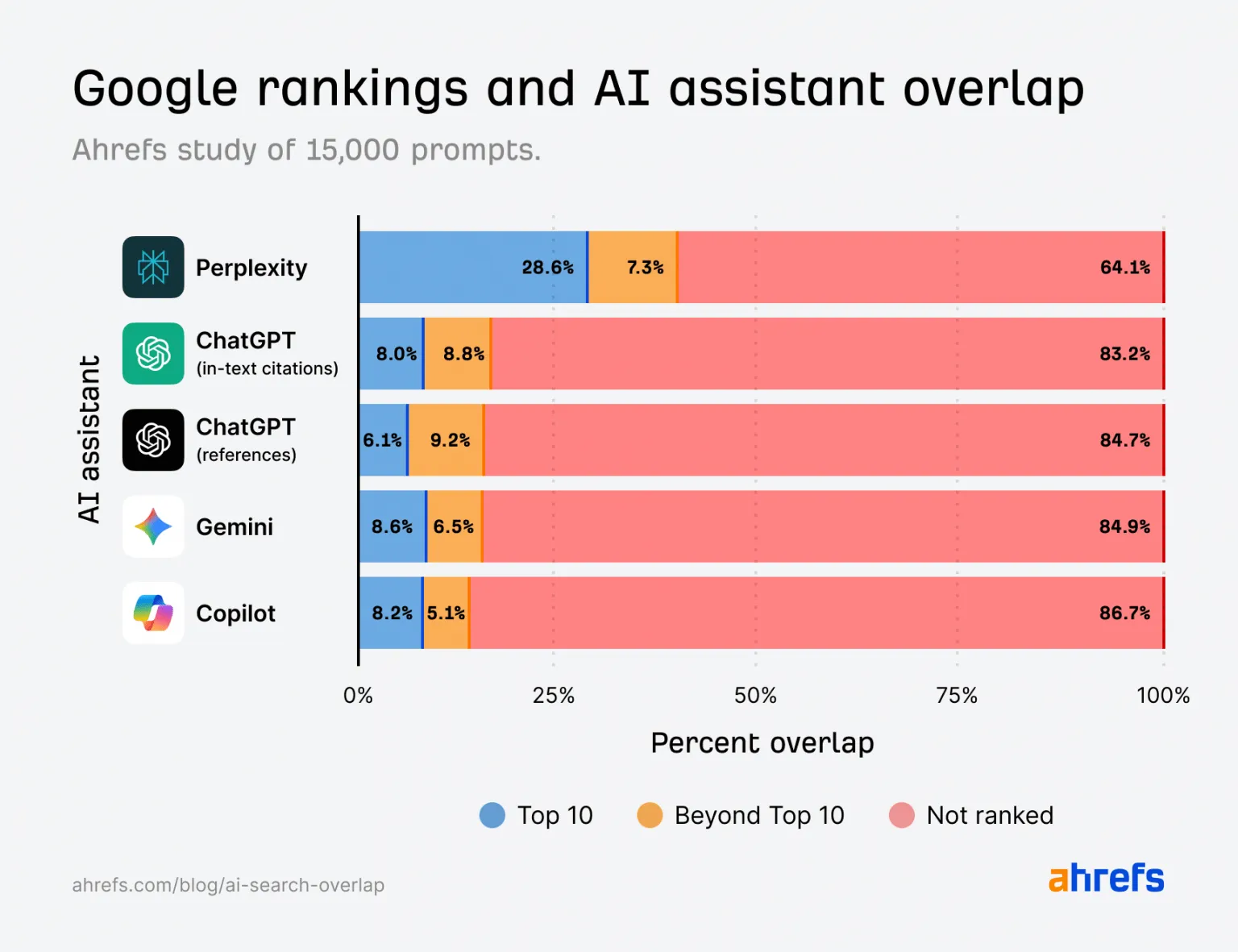
- Ahrefs analyzed 15,000 prompts and found that, on average, only 12% of the URLs cited by ChatGPT, Gemini, and Copilot appear in Google's top 10 for the same query.
- ChatGPT skips your high-ranking content because ranking and getting cited are two different jobs, and the pages ChatGPT quotes have specific traits.
- ChatGPT cites your competitors ahead of you because of three fixable reasons: thin entity signals, unstructured claims, and missing source attribution.
- Most of the fixes happen on pages you already own, and you can start today without buying a single new tool. The fix-by-fix path: strengthen your entity footprint, rewrite claims to be extractable, add attribution and primary data, then test across engines.
- Engines rarely agree. Only 2.37% of cited URLs show up across all three major engines for the same prompt, so you have to earn and check each one separately.
- If you do one thing this week, make your best-ranking page's key answers quotable and sourced.
Ranking on Google and Getting Cited on LLMs Are Two Different Jobs
Being #1 in Google and being cited by ChatGPT are two separate competitions with two separate rulebooks. Google's job is to rank a link it thinks is relevant and authoritative. An LLM's job is to assemble an answer, so it retrieves candidate pages, then lifts the cleanest, most quotable, most trustworthy sentence it can attribute. If your best insight is buried in a paragraph or has no source attached, the model reaches for a competitor whose text is easier to quote.
These statements are not just my assertions; the data backs them up.
In an Ahrefs AI search study analyzing 15,000 prompts, the researchers discovered that roughly 80% of AI-assistant citations don't rank anywhere in Google for the original query. And the alignment varies wildly by engine: Perplexity favors Google-ranked content (28.6% of its citations sit in the top 10), while for ChatGPT and Gemini, that number hovers around 8%.
There is one big exception. Google's own AI Overviews still lean on the classic SERP. The same Ahrefs study found 76% of AI Overview citations come from pages in the top 10.
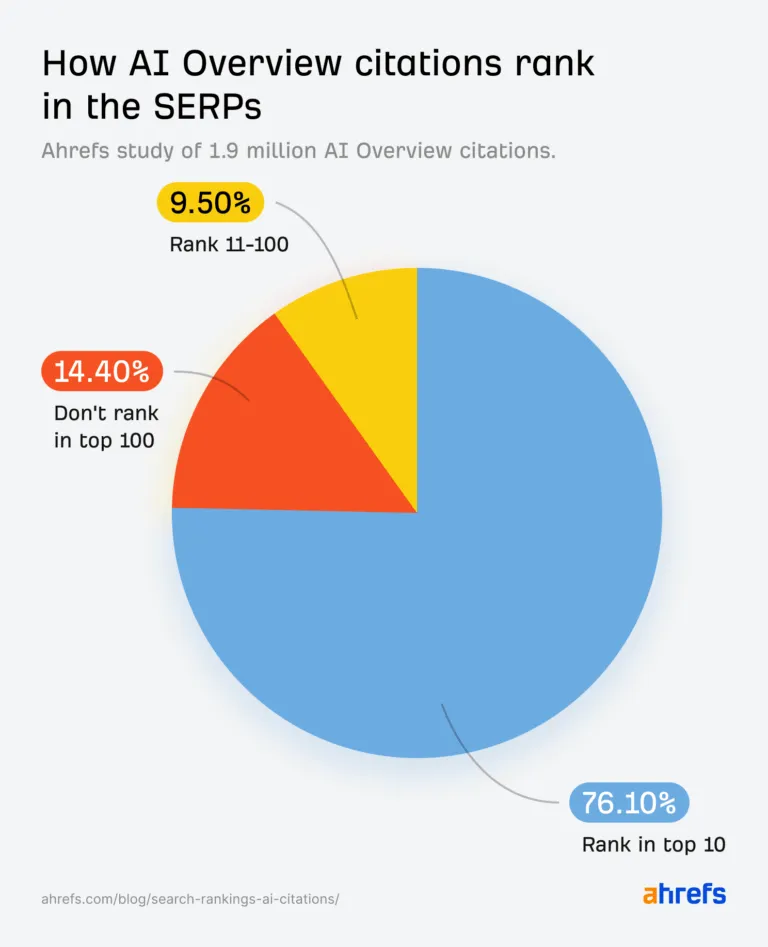
These insights reflect what we’ve been saying about AI changing SEO faster than most teams think. Your core ranking factors still matter for AI Overviews, but they're no longer enough to get cited on ChatGPT, Perplexity, and other chat assistants, where buyers increasingly conduct their market research.
It gets even more fragmented. Kevin Indig's analysis of 3.7M citations found that only 2.37% of cited URLs appear across all three engines for the same prompt, while 91% show up in only one.
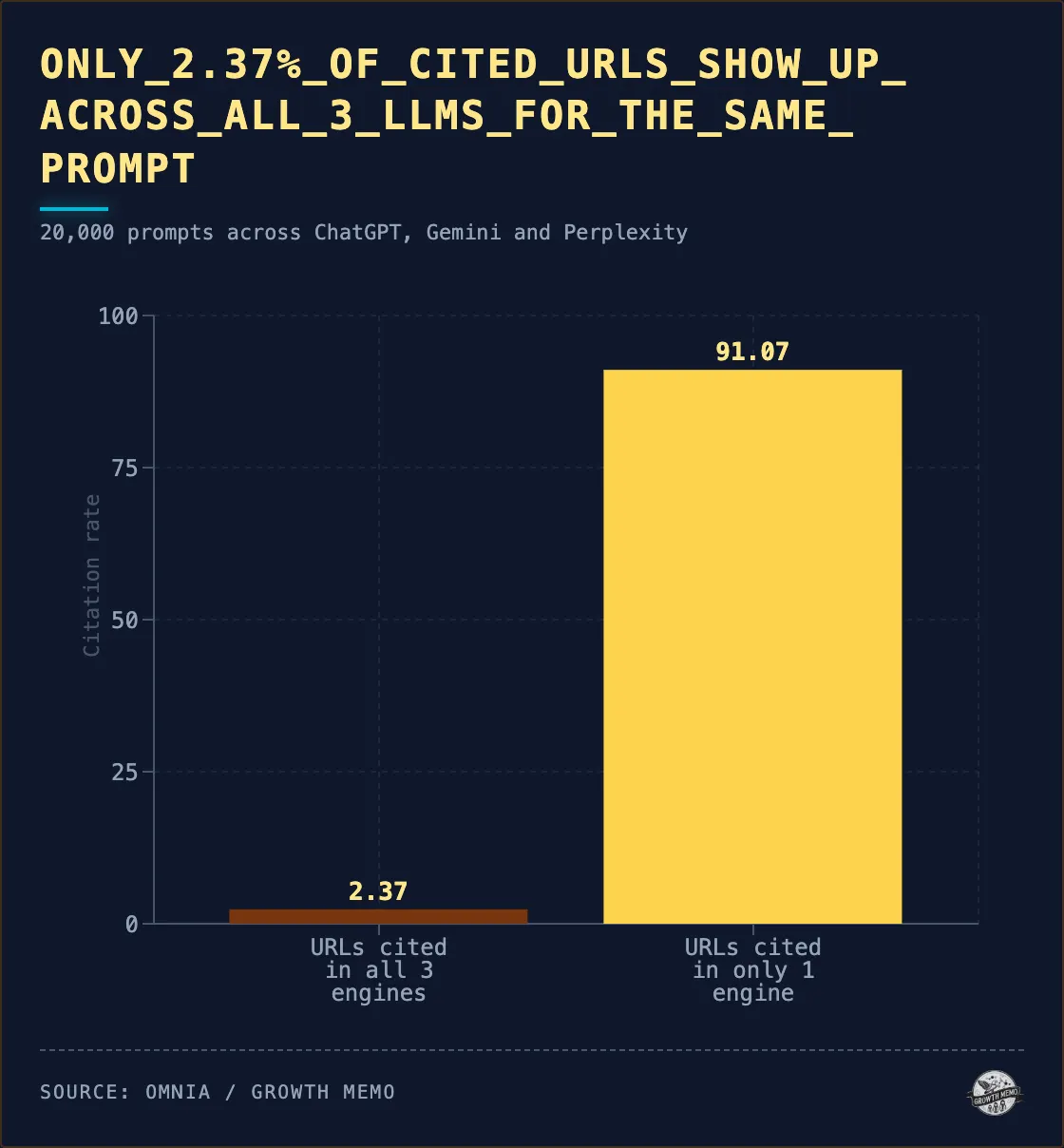
As Kevin puts it;
"A brand can look strong in aggregate and be invisible in 2 of 3 engines."
Paraphrasing him, it’s no longer enough to get ranked on the first page, even in the number one spot, on Google SERP. It has become critical that your business adopts a comprehensive SEO, AEO, and GEO strategy to ensure your pages are cited by as many answer engine, ChatGPT, Perplexity, Gemini, Copilot, etc., as possible.
Why ChatGPT and Other Answer Engines Cite Your Competitor Instead of You
When ChatGPT names a competitor ahead of you, it's almost always one of three fixable failures: (1) it doesn't recognize you as a credible entity, (2) it can't cleanly lift your claims, or (3) it has nothing safe to attribute.
The problem is more popular than many marketers think. I’ve had clients ask me why AI answer engines name a competitor ahead of them, despite having more solid coverage and Google rankings.
Let me break down the three causes, then I’ll introduce you to the solutions.
Thin Entity Signals
Gen AI models can cite your competitors ahead of you if they don't recognize your brand as a credible source on the topic. These answer engines decide who's trustworthy largely from off-site signals, how often and where your brand is mentioned across the web. Many research studies have highlighted that the referring domain is a strong predictor of ChatGPT citations: pages on domains with very few referring domains get a lower number of citations, while the most-referenced domains have more referring domains.
Off-site reputation has become more important than ever. According to Lily Ray, Founder of Algorythmic, in her “A Reflection on SEO & AI Search in 2025:”
"AI Search has tipped the scales, making off-site signals like brand mentions on popular websites, top-tier reviews, and a positive social media reputation, more important than ever."
It also matters where those signals live: Profound's AI Platform Citation Pattern Analysis of 680M citations found ChatGPT's single biggest source is Wikipedia, while Perplexity leans heavily on Reddit. If these engines’ trusted sources have never heard of you, it’s very unlikely that the answer engine has heard of you.
This is the semantic, entity-based layer that now sits underneath and supports search.
Unstructured Claims
Answer engines also fail to cite your page when your best points are valid but are buried in prose the model can't lift cleanly. ChatGPT and other answer engines reward self-contained statements they can quote in isolation. When your insight is stitched across three sentences with a bridging sub-concept between them, it's not quotable, so the model grabs a competitor's crisp one-liner instead.
How you structure your sentences, paragraphs, and sections plays a key role in whether you’re cited or not. Sections of about 120–180 words are associated with strong ChatGPT citation rates and are its recommended structural sweet spot.
Position matters too: an analysis of 1.2M ChatGPT answers (18,012 verified citations) by Kevin Indig found that 44.2% of citations come from the first 30% of a page, while content in the final third is cited far less often.
The academic evidence agrees that how (and where) you present a claim changes whether it gets pulled. A peer-reviewed GEO study from Princeton and collaborators showed content tweaks can boost visibility in generative engines by up to 40%.
Missing Source Attribution
If a claim has no data and no named source, there's nothing the model can safely cite. ChatGPT and other answer engines are cautious about echoing unverifiable statements, so pages that cite figures and name authoritative experts give the model something safe to quote with your URL attached, of course.
The correlation is clear in SE Ranking's data: pages with expert quotes averaged 4.1 ChatGPT citations versus 2.4 without, and data-dense pages (19+ data points) averaged 5.4 versus 2.8. The Princeton GEO study points in the same direction – statistics, cited authoritative sources, and expert quotations were among the highest-performing content moves.
Key takeaway? Bare opinions don't get quoted. Sourced specifics do.
The Fix-by-Fix Checklist to Earn Citations on Answer Engines like ChatGPT, Perplexity, and AIO
You can manually fix all three ChatGPT citation failures on your existing pages, in roughly this order of impact. None of the solutions necessarily requires new software.
1. Strengthen Your Entity Footprint
Make it obvious to both people and models who you are and why you're credible. Use your brand name consistently across the web, tighten your About and author bios with real credentials (experience, roles, links), and earn mentions in third-party sources engines already trust. Because referring domains are a top citation predictor, you have to double your efforts in digital PR and building a genuine community presence.
As Kevin Indig notes on the BuzzStream Podcast:
"LLMs form answers by pulling consensus from reviews, publishers, and other brands, which is exactly what PR is built to influence."
Practical moves:
- Get quoted in industry publications
- Keep your Wikipedia/Wikidata presence accurate where you legitimately qualify, and
- Contribute real value on Reddit, Quora (Perplexity and Google AI Overviews lean on them), and other industry communities.
These are the same methods that promote AI search visibility more broadly.
2. Rewrite Claims to Be Extractable
- Turn your key points into clean, standalone statements a model can quote without editing
- Lead every section with a one- to two-sentence direct answer, then expand
- Keep sections in that 120–180-word sweet spot
- Use clear H2/H3 headings, and
- Put the most quotable version of your answer high on the page, since the opening third of a page earns a disproportionate share of ChatGPT citations.
- Convert dense comparisons into tables.
The goal: any single sentence should make sense lifted out of context.
This is the cheapest, fastest fix. You're not writing new pages; you're making existing ones liftable.
3. Add Attribution and Primary Data
- Give the model sourced facts it can repeat with confidence
- Cite named studies with links
- Add your own original data or first-party benchmarks, and
- Attribute expert quotes.
- Keep the page and all data current.
AirOps’ 2026 State of AI Search discovered that pages updated within the last three months earned more citations than outdated pages.
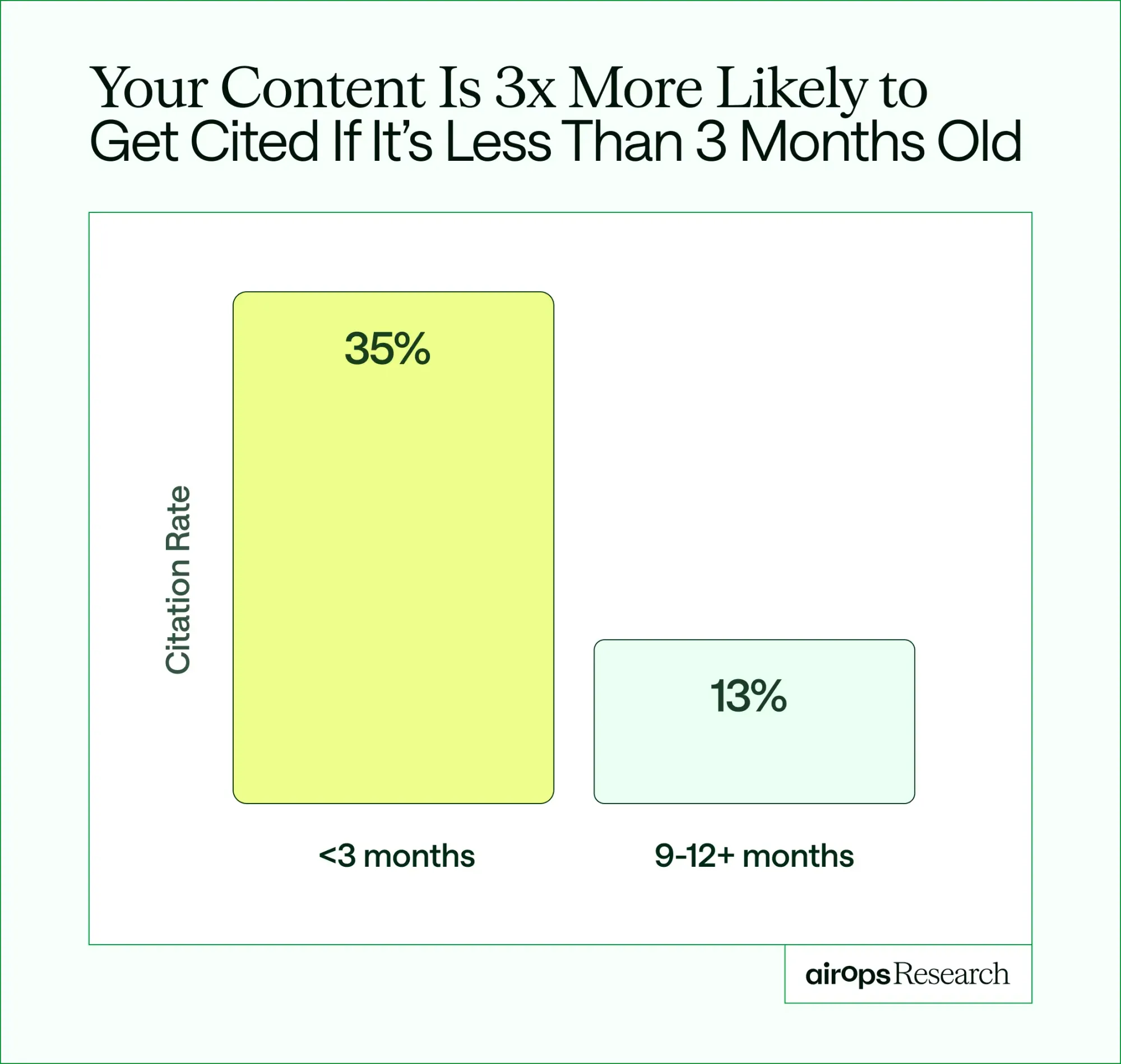
Also, when you can, publish relevant proprietary data. If you publish even one proprietary number, a survey result, or an internal benchmark, you become a primary source that other pages (and models) quote and link to. This increases both your AI search citation potential and domain authority.
4. Test Your Visibility Across LLMs
Check whether the fixes actually landed in each engine separately. Open ChatGPT, Perplexity, and Google's AI mode, and prompt them with the real questions your audience asks, the same way you'd use ChatGPT for research, but pointed at your own coverage.
Note who gets cited and named on each platform. Because 91% of citations are engine-exclusive, winning ChatGPT tells you nothing about Perplexity or Google Mode. Repeat the process for all the platforms.
Do this manually to start; it costs nothing. If you're managing many pages, AEO/AI-visibility tracking platforms can automate the monitoring at scale. There's a growing field of AI visibility tools. You can check out how the leading AEO trackers compare and pick what works for you.
Just don't skip the test: without it, you're optimizing blind.
What to Fix First This Week
If you only have time for one move, make your single best-ranking page's key answers extractable and sourced; that's where authority already exists, so it converts to citations fastest.
Concretely, this week: pick the one page that ranks well but gets no citations on ChatGPT or other answer engines. Rewrite its opening 30% so the core answer is a direct, quotable sentence. Add two sourced statistics with links to the original studies. Update the publish date. Then, about a week later, re-prompt ChatGPT and Perplexity with your target question and see if you've entered the answer. Repeat on your next page. The good thing is that you're not chasing a new content program; you're only upgrading pages you already own into citation-ready assets, which is the whole point of a durable AI-era marketing playbook.
FAQ on How to get Cited by ChatGPT and other LLMs
Why does ChatGPT cite my competitor instead of me, even though I rank #1?
Ranking and citation are different jobs. ChatGPT retrieves and quotes self-contained, attributed text and favors recognized entities; only about 12% of AI-cited URLs rank in Google's top 10. If your best claims are buried in prose or unsourced, the model quotes a competitor whose text is easier to lift.
Do you need to rank on Google to get cited by ChatGPT?
No. Roughly 80% of AI-assistant citations don't rank anywhere in Google for that query. The exception is Google's AI Overviews, where 76% of citations come from top-10 pages. So classic SEO still helps Overviews, but not standalone assistants.
How do I get cited by ChatGPT?
Strengthen your entity signals (brand mentions on authoritative sites), make claims extractable (lead with direct answers, keep sections 120–180 words), add sourced statistics and named quotes, keep content fresh, and test across engines. These map to the traits that studies link to higher citation rates.
What is answer engine optimization (AEO)?
AEO is optimizing content so that answer engines, ChatGPT, Perplexity, and Google AI Overviews can extract and cite it directly, rather than just ranking a blue link. It emphasizes quotable answers, clean structure, and entity/authority signals.
What's the difference between AEO and GEO?
They overlap heavily. AEO focuses on becoming the cited answer in answer engines; GEO (generative engine optimization) is the broader practice of increasing your visibility inside AI-generated responses. They’re similar, with a few differences.
Does ChatGPT use Google rankings to pick citations?
No. Only about 8% of its cited URLs sit in Google's top 10. Perplexity aligns more closely (28.6%), and Google AI Overviews largely follow the SERP (76%).
What content gets quoted most by LLMs?
Well-structured content with statistics, cited authoritative sources, and expert quotations. The peer-reviewed GEO study (KDD 2024) found these can boost visibility in generative engines by up to 40%, and SE Ranking's data links dense stats and expert quotes to more ChatGPT citations.
How important are backlinks and referring domains for AI citations?
Very. In SE Ranking's study of 129,000 domains, referring domains were the strongest predictor of ChatGPT citations, a proxy for how well the model recognizes your brand as a credible entity.
Does content freshness affect AI citations?
Yes. Pages updated within the last three months get more ChatGPT citations than outdated pages. Refreshing existing pages is a fast lever.
Where on the page should my key answer go?
Near the top. Kevin Indig's analysis of 1.2M ChatGPT answers found that about 44.2% of ChatGPT citations come from the first 30% of a page. Lead each section with a direct, quotable answer before expanding.
Why is my brand visible in Perplexity but not ChatGPT (or vice versa)?
Because engines rarely agree. Only 2.37% of cited URLs appear across all three major engines, and 91% appear in just one. ChatGPT leans on Wikipedia; Perplexity leans on Reddit. You have to earn and test each engine separately.
How do I check whether ChatGPT and Perplexity cite my page?
Prompt each engine with the real questions your audience asks, and note which sources it cites and names. Do it per engine, since visibility rarely carries across them. AI-visibility tools can automate this at scale.
Will the FAQ schema get me cited by ChatGPT?
Not reliably on its own. SE Ranking's data showed pages with FAQ schema didn't out-cite those without it. Clear, self-contained answers and strong entity signals matter more. Use FAQs for reader clarity, not as a magic switch.
Can I improve AI citations without creating new content?
Yes, it's the fastest path. Rewrite existing top-ranking pages so their answers are extractable and attributed, add sourced stats, and refresh dates. You're adding citation-ready traits to pages that already have authority.
How long until ChatGPT and other answer engines pick up my changes?
It varies by engine and refresh cycle; often days to a few weeks. Re-test your target prompts about a week after making changes, and keep monitoring, since results differ by engine.
Article contributed by Christopher Iwundu
Christopher Iwundu is a content writer, SEO/AEO specialist, and strategist helping B2B SaaS, tech companies, and enterprises generate revenue through problem-first SEO, content, and scalable Content Engineering systems.