
AI is changing the way Google understands content. Now, the algorithm isn't ranking keywords anymore — it listens for meaning, intent, and trust. The search experience has become more human.
A recent Forbes report shared that 80% of consumers now rely on AI summaries for at least 40% of their searches.
Now, the pages that win aren't the ones filled with words, but the ones filled with real value — answers that truly help people.
But there’s a twist… most websites haven't been able to tune up with this. Since Google's new AI systems, like RankBrain, Gemini, and the Search Generative Experience (SGE), now think like humans. They read between the lines, get to the core of what users really want, and rank honest, useful content.
So, be ready — this guide will show you:
- How AI decides what content shows up first on Google
- Why old SEO tactics don't work anymore
- How to use smart AI tools to plan better content
- Why real experience and trust still matter most
- Simple steps to stay ahead in this new AI-driven world
By the end, you'll know exactly how AI is changing SEO — and how you can use it to grow faster.
What Does AI Mean for SEO Today?
AI in SEO means using smart technology — like machine learning and natural language tools — to help search engines understand what people really want, not only what they type.
In past years, Google focused on keywords in terms of search. Today, it looks for meaning (the same match of the purpose). AI systems such as RankBrain, MUM, and Gemini make search results feel more human. They read tone, context, and intent — much like a person would in a real conversation.
When someone searches “how to boost website visibility," Google's AI doesn't just match the words. It figures out whether the user wants SEO tips, traffic tools, or marketing help, then shows results that actually solve the problem.
This change means success now depends on how valuable and genuine your content is, not how many search terms you've inserted.
If your page gives a sense of human touch, answers questions clearly, and shows real experience, AI will recognize it.
How has AI Changed Search Algorithms and Ranking Factors?
Google search has learned to think more like us. It notices what people click, how long they stay, and which answers feel useful. It notices what they click, how long they stay, and what feels helpful.

AI systems like BERT, MUM, and SGE help Google understand ideas and meaning, not just exact keywords. They connect topics the way people do — by seeing the story behind the search.
According to Google Search Central, Google now looks for helpful and authentic content when deciding what to show first.
Here's what AI looks for:
- Expertise: Is the writer someone who truly knows the topic?
- Experience: Does the content come from real-world knowledge or practice?
- Authoritativeness: Do other trusted sources or people recognize them as reliable?
- Trust: Can the facts be checked and verified?
Websites that follow these rules — known as E-E-A-T (Experience, Expertise, Authoritativeness, Trustworthiness) — are likely to rank higher.
The new rule is simple: write for people, and AI will understand you.
Why Old-Style Keyword SEO Doesn't Work Anymore
It's not about stuffing keywords anymore (these tactics have no scope). Google wants users to be satisfied, so now the content has to be spot-on with users' search intent.
When you write something like "AI tools for content optimization," Google now sees it from a different angle. It connects ideas like "AI tools,” “content," and "SEO strategy" to understand the full concept, not just the words.
Just a little tip for you:Don't repeat the same keywords again and again. Instead, write around one big idea and use related terms that feel natural (It keeps the reader engaged).
For example, Ahrefs now writes deep guides on full topics rather than single keywords. Clearscope does the same — it checks if an article fully explains a subject. That's the kind of content Google trusts and rewards today.
How AI Tools are Changing Keyword Research and Content Strategy
AI has changed the way we plan what to write. It's like having a personal helper who studies what people search for and tells you why they're looking for it.
Instead of guessing which words to use, AI looks at patterns — what people click on, what they read, and what keeps them interested. It then suggests topics that actually solve problems, rather than wasting time filling pages.
For example, if people keep searching “how to grow a small business,” AI might notice that most of them really want marketing tips or budget tools (not just the information). That helps you write something real and useful — not another boring content copy.
Smart tools like Frase, SurferSEO, and Jasper study search patterns, compare topics, and suggest ideas that match what people actually want to know. They group similar keywords together to build stronger topics.
Here's what these tools do best:
Instead of spending hours thinking about what to write, these AI tools help you make content that's easy to read and truly helpful.
How Google's SGE is Changing Online Traffic
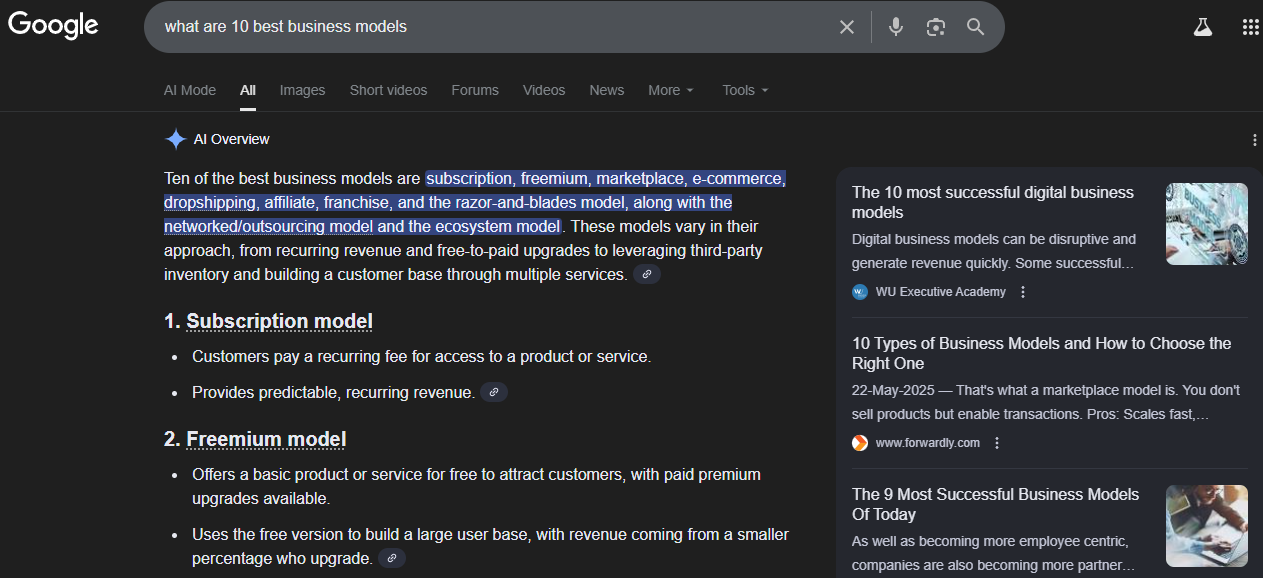
Google’s new Search Generative Experience (SGE) is changing how people find things online. Instead of showing a list of links/websites in a second, Google now gives a short answer at the top of the page, made by AI.
It's a bit like having a super-smart friend who reads everything for you and then sums it up in seconds. For sure, it is great for users — they get answers in a few seconds. But for websites, it's a different story.
Since people already get quick answers, many don't click on the links anymore. A study from Digiday found that some websites lost 10–25% of their visitors after Google started using these AI summaries.
So, the real question is — what can you do? This is where something new called Answer Engine Optimization (AEO) comes in. It's all about writing in a way that helps smart systems and algorithms — like Google's AI — easily find and share your answers.
Here are a few tips that will be helpful:
- Use questions and short answers that people might ask online.
- Add FAQ or How-To sections to help Google find key info.
- Write with clear, friendly language so readers (and AI) can follow easily.
SGE isn't bad news — it's just different. If you focus on helping people, Google's AI will help more people find you.
And once you've built a solid content plan, it's time to look at how Google's new search experience actually delivers it to readers.
How AI is Changing Content Creation and Optimization
In past years, writers tried to please search engines. Now, we write to help people — and show search engines why our content matters. That's what makes a difference.
AI-optimized content means writing that's easy for both people and AI to understand. It should be clear, simple, and full of real answers that actually help.
These days, great writing isn't about adding strong words or stuffing lots of facts. It’s about sharing real experiences, using short examples, and writing in a way that feels human.
AI can find facts fast, but only humans can make those facts feel real. The way you explain things, tell stories, or share examples of what you've learned makes your writing special. When readers can see that you've really done what you're talking about, they trust you more — and that's what helps your page stand out.
Here's how you can make the best use of AI:
- Use AI to get ideas, not to write the whole piece for you.
- Add your own experiences and insights — that's what makes your content real.
- Always double-check your facts' sources so your readers know you're reliable.
- Keep paragraphs short and easy to read — both people and AI like to the point answer.
At the end of the day, search engines follow people. If your writing helps readers, feels real, and builds trust, AI will see — and reward you for it.
Remember, great content opens the door, but a well-built site keeps people inside — and that’s where technical SEO and on-page signals come together.
How AI Affects Technical SEO and On-Page Signals
AI has also changed how websites are checked and ranked. It looks at how fast your page loads, how easy it is to use, and how clearly everything is set up.
Here's what matters most:
- Smarter Crawling: AI looks for pages that open fast and are well-organized. These pages get found and listed first.
- Better Structure: Using clear titles, short paragraphs, and simple menus helps both people and AI move around your site easily.
- Helpful Markup: When you add FAQ or How-To sections, AI can understand your content better and show it in search results.
- Voice and Visual Search: AI can now “see” pictures and “hear” voice questions, so adding image text and clear answers helps you reach more users.
In simple words, a clean, easy-to-use website makes both people and AI happy.
If your site feels simple, loads fast, and conveys real answers, Google will notice — and reward you for it.
Can AI Predict What People Want Better than Professionals?
AI is getting really sharp at understanding why people search, instead of what they type. It watches how we act online — what we click, how long we stay, and what we skip — to figure out what we really need.
Here's how it learns:
- Time on Page: If people stay longer, AI knows the content is useful.
- Quick Back Clicks: If users leave fast, it means the page is vague.
- New Searches: When someone changes their question, AI learns what didn't work the first time.
By studying these actions, AI can guess the goal behind a search:
- To learn something (like “how AI is changing SEO”)
- To find a certain website
- To buy a product or service
- To find something nearby (like “cafes near me”)
Big sites like Amazon and Booking.com already use this kind of AI. It helps them show the right products or hotels in much less time, sometimes even better than people can. But even with all its smart tricks, AI still misses a core factor — feelings or human connection. It doesn't truly understand tone, care, or emotion. That's where the human element makes the real difference.
AI can track patterns, but only humans can feel what others need. And that's what keeps search true, helpful, and human.
What AI-Based Strategies Should You Use for SEO Now?
AI isn't here to take your job — it's here to make it even simpler. For Marketers, AI is a helpful tool and part of their everyday SEO strategy. It helps them plan content, understand what people search for, and decide what to post next.
Here's how they use it in their SEO work:
- Spot new trends early: AI looks at thousands of searches and shows what people are starting to focus on. This helps writers create content first — and rank faster.
- Know what people want: AI can tell if someone wants to learn, compare, or buy. That helps teams write the right type of post for each goal.
- Fix old content: Marketers use AI to find pages that need updates or are missing key info, then make them better.
- Turn data into ideas: AI turns long lists of numbers and keywords into simple, useful insights that are easy to act on.
- Save time: Instead of spending hours on research, teams use AI to get outlines, ideas, and SEO tips in minutes.
Big industry names like HubSpot and Semrush do this too. Their writers use AI to understand what readers want, but they still write every piece with a real, human voice.
The key is balance — let AI do the heavy research and pattern work, but keep your heart and voice in the story. That mix builds trust, gets better rankings, and keeps your audience coming back.
What Are the Risks of Relying Too Much on AI in SEO?
AI is smart — but it's not perfect. And that can be a problem, because the technology doesn't know your voice or your real-life experiences. So the content may feel plain, and readers may not trust it.
Why you don't have to over-rely on AI:
- Facts can slip. AI pulls ideas from many places, so small errors can appear. If facts are wrong, trust drops.
- Tone can go flat. The wording may be correct, but it may not sound like you. That makes readers leave early.
- Pages can feel the same. If many people use the same tool, posts start to sound alike. That hurts your brand image.
- Signals can weaken. Search engines look for real value. If your page repeats ideas, rankings can fall.
What to do instead:
- Use AI to collect ideas; use your knowledge to choose and shape them.
- Add your own story, steps, or results so the page feels real.
- Check every claim and add a source when needed.
- Keep sentences short and clear, and use helpful headings so people stay.
Here's a simple rule of thumb:
Sometimes AI mixes up facts or misses the little details that matter most to your readers. It doesn't know what makes a story feel real or what builds trust. That’s why content made only by AI feels a bit off — it lacks the personal touch that people can relate to.
And that’s the main reason why relying only on AI isn't worth it. It may help you write in less time, but it can't understand the human connection.
The Future of SEO in the Age of AI
The future of SEO will look entirely different — and a lot more exciting. Search isn't just about typing words anymore. People are now talking to voice assistants, using pictures to search, and asking questions as if they were asking a friend.

AI tools like ChatGPT and Google Gemini are learning to read text, watch videos, and even understand images — all at the same time. That means your website won't be judged by words on a page, but by how well everything connects: pictures, tone, speed, and trust.
In the coming years, both humans and AI will decide what makes valuable content. Your words must make sense to people and to machines. The more honest, clear, and helpful your page is, the better it will perform.
Experts from Moz and Search Engine Journal believe the best strategy will be “entity-first SEO.” This means Google wouldn't accept keyword-based content — it will look at who you are, what your brand stands for, and how much people trust you.
In simple words, the future of SEO isn't about being seen — it's about being believed.
Wrapping up…
AI has completely changed how SEO works — which is actually not a bad thing. It's helping value-based content come to the top. Search engines are now smarter, but they still need something only humans can give — a real, honest connectivity.
The websites that stand out today aren't the ones stuffed with keywords or written by machines. They're the ones that sound real, answer questions in a true way, and make people feel understood. That’s what Google — and your audience — is looking for.
So, let AI help you plan smarter, but keep the heart of your content your own. Write like you're talking to someone who needs help. Be clear, be kind, and be real.
Because in the end, SEO isn't about showing up on Google — it's about showing up for people.