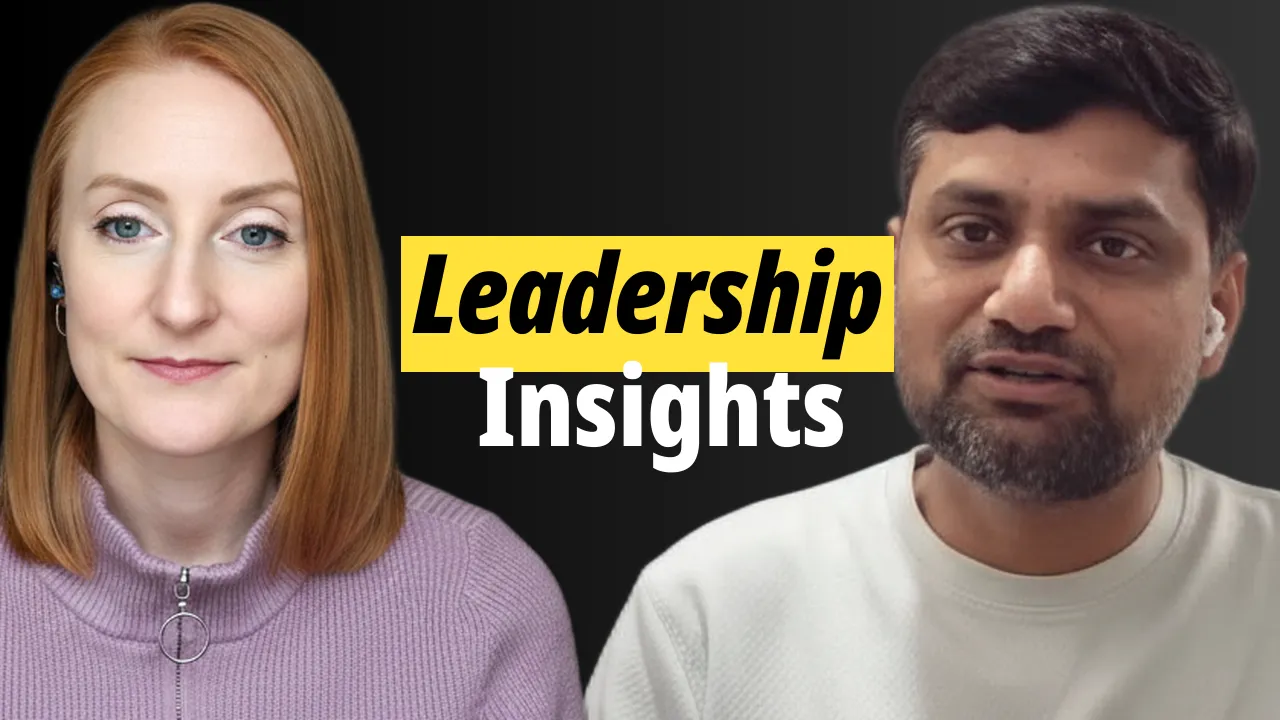
In this podcast episode, I (Sam) interview Nashay, a leader in manufacturing operations, who shares her journey from a mechanical engineer to a global leader.
We discuss the importance of transitioning from technical roles to leadership, the challenges women face in male-dominated industries, and the skills necessary for aspiring leaders.
Nashay emphasizes the significance of cross-functional skills, work-life balance, and hiring for agility and a growth mindset. The conversation also touches on the importance of team connection and psychological safety in the workplace.
Here is detail conversion
Takeaways
- Nashay transitioned from mechanical engineering to leadership roles.
- Asking bigger questions can help in career advancement.
- Taking on smaller leadership roles can provide valuable experience.
- Balancing work and life involves making trade-off decisions.
- Hiring for an agility and growth mindset is crucial.
- Healthy friction in teams can lead to better ideas.
- Staying connected with teams enhances performance.
- Psychological safety is important for team success.
- Reflecting on successes helps in recognizing team efforts.
1. Introduction to the Podcast and Guest
Sam Suthar (00:00)
Alright, so welcome to Sam's podcast. I'm Sam, a serial entrepreneur, marketer and two-time founding director. Currently, I'm working on Middleware, where we are building an end-to-end observability platform. In this podcast, I interview world-class tech entrepreneurs, leaders, founders, and CEOs to learn about their experiences building and growing their businesses.
In today's episode, my guest is Nashaye. Nashaye is the president at Tsubaku Nakashima, who brings a powerful perspective on career growth, having worked as a mechanical engineer in her early years and later transitioning from mechanical engineering to a global leadership role in manufacturing operations.
Before that, she also played a key role at DuPont, Caterpillar, and John Deere. So, welcome late to the podcast, Nashaye, and really thanks for joining us today.
Great. So I describe a little bit about you, but then it's really great if you can just share your experience and how you started your career as a mechanical engineer. Then you transition from mechanical to a go-to-market expert. Then you did to product engineering. Now you are the leader, especially focusing on the manufacturing industry. So we'd love to know more about you and how you started your career.
2. Nashay's Journey from Mechanical Engineer to Leader
Nashay (01:27)
So as you alluded, I started my educational career in mechanical engineering. I was always really impressed with it how, you know, machines run and so that was an area that I was really interested in. So I my undergrad in mechanical engineering and through that experience I'd had multiple internships at different companies and where I really had some hands-on experience.
And I, at to time, noticed that to world was becoming much more global. And so there was a need for us to really be able to bridge across countries, which led me into wanting to study another language and really master another language. So I decided to learn Chinese during my undergraduate degree.
And through that, I felt I was pretty strong in Chinese, but still not able to master it on to technical level. So I decided to actually do my masters in China, automotive engineering masters taught in Chinese in China. ⁓ And then while I was in China, I also had worked at Caterpillar doing commercial marketing work.
I continued my career at Caterpillar, really focused on more engineering work. And after Caterpillar, I did an MBA and then I continued my career in a series of product line management roles at both DuPont and then at Redwood Materials as well. And after that, I took to general management role at Tsubaki Nakashima.
3. Transitioning from Technical to Non-Technical Roles
Sam Suthar (02:56)
Amazing, that's what I think is a very interesting journey. So you started as a mechanical engineer, right? What makes you to change from mechanical to a non-technical? Because you know that a marketing role is, of course, a non-technical role, and even if you go to a product marketing role, it's again a non-technical role. So what makes you change this? Is that something you are not that good at?
engineering side. I see a lot of people who study engineering, but they never become engineers. They end up with something like a comedian, marketer, or something else. But what exactly happened with it? You changed yourself from an engineer to a non-technical person.
Nashay (03:36)
Yeah, it was a funny transition actually, because I was in Beijing, and I wanted to work in Beijing, and I really wanted to do engineering. I'd studied engineering for a long time, but ⁓ to caterpillar whom I wanted to work for didn't have an engineering department in the Beijing office. So they offered me a role in more of a marketing experience.
At the time, I was a little reluctant because I felt very strongly like I'm a technical expert, right? to do engineering, but I took the opportunity, and it was a great experience. The caterpillar at the time was⁓ had recently acquired a Chinese company. And so we were launching a dual-brand strategy into the Chinese market. And it really gave me, ⁓ a lot of additional experience and another dimension to marketing that I didn't have previously. And that's, even though I had subsequently done engineering again, but I was always really drawn back to kind of that business aspect and to a business outlook on things, which, although it led me back into a general management direction.
4. Skills for Technical Professionals to Transition to Leadership
Sam Suthar (04:42)
Amazing, And I I see like if somebody hold a technical background and if they enter in to leadership role, it play pretty good role, because they already know a lot of engineering stuff, So I have a very interesting questions around that only.
Only a few technical people develop those leadership skills because they mostly end up with it, coding or designing or just configuring hardware or software, something like that.
So, based on your experiences, how can a technical person transition into an executive leadership role? What are to skill set that required?
Nashay (05:21)
Yeah, I would say that there's no one path that I would necessarily recommend because each person is different and each career trajectory is very different. But what I encourage people to do and what I did with it in my career is I always tried to ask bigger questions about what is helping the business run, or why our customers are purchasing our products. Like, what is that differentiator? And so taking time to really look at the bigger picture, I think, helped me position myself better to get to general management roles.
Another recommendation I have is that part of the reason I ultimately transitioned into product line management was that product line management as a function really interacts with all of the other functions on the team. So it's a really strong cross-functional experience where you have oversight, and you're able to work directly with it a lot with other functions and really have a deeper understanding at that level.
And then last, especially if you're early in your career, I encourage you to take on smaller leadership roles, even volunteer roles that will help you get a little bit more experience and exposure to what other parts are going on at the company.
5. Building Resilience in Male-Dominated Industries
Sam Suthar (06:37)
Yeah, I think that's interesting, taking some volunteer role because most of time these people are busy with technical things and they never end up with it, they mostly are introvert, they never try to be extrovert.
A few interesting things about men, especially in industries like manufacturing, it's actually a male-dominated industry, industries where most of the time women are scared to work because of concerns like privacy, security and safety, right?
So how do you build yourself or how can a woman like you build resilience and confidence in male-dominated industries and become a leader?
Nashay (07:22)
Yeah, so I mean, for me, jumping into an industry with a few women is actually an exciting challenge. like to step out of my comfort zone and get into those experiences where I'm challenging myself.
I also want to share that manufacturing has changed a lot over the years. It's no longer like, you know, a dirty workplace that you might have thought of in the industrial revolution. It's really pretty exciting. There's a lot of autonomy now, like robotics within factories. There's also integration with it AI that's happening right as we speak. And it's really exciting.
So I think a lot of things even within to industry have shifted and make it much more welcoming for to a diverse workforce.
6. Cross-Functional Skills and Multitasking in Leadership
Sam Suthar (08:11)
Yeah, that's something very interesting because I see the workplace changed now. They are more advanced, where anyone can work.
You know, being a leader requires cross-functional skills as well as being a multitasking person. That's why I understand that once you become a manager or leader, you need to do your work, but at the same time, you need to manage people, and sometimes, if they are not able to work, then you have to clear that backlog.
If they are working slowly, we need to find ways to improve productivity and adopt AI to help us make it faster, right?
So how can middle-level people or aspiring leaders build their cross-functional skills, multitasking so that they can work well themselves, as well as even go beyond the team and create different kinds of frameworks? So, what's your position on that?
Nashay (09:18)
Yeah, my recommendations are just to take an active interest in other functions. And also, if you're speaking with it your manager, I would, and this is what I done in to past too, is actively share that you're interested in doing more, maybe different cross-functional work because...
Sometimes projects exist, and if people aren't aware that you're looking for an opportunity, your name might just not come to mind. It's not anything intentional, of course, but to more you can share and be proactive about it, I think to more opportunities that will arise.
7. Balancing Work and Life as a Leader
Sam Suthar (09:53)
Yeah, but this can't be happening in nine to five work, right? So I think to leaders always need extra time to work. And that's where they face work-life balance. Because they have families and have a lot of social work.
So, how people can balance themselves work and life where even by doing all these activities cross functional things some extra curriculum things at place.
Nashay (10:22)
Yeah, I find it always difficult. Like every day we're facing trade-off decisions and we just have to make...
There's always going to be a trade-off. So if you select to do one thing, you're trading off something else, whether it's your free time, maybe an opportunity to go on vacation. There's always a trade-off decision. So I think each individual really has to look at what you're trading off and understand for yourself if ⁓ it's worth it.
Tools like managing your calendar in different ways. I try those, but I tend to kind of revert back to thinking of it as a trade-off. We're always making trade-off decisions, so just understanding what you're trading off at the time you're making the decision is helpful.
8. Hiring the Right Talent for Your Team
Sam Suthar (11:11)
Okay, that's interesting. Cool. And how do you hire people Because I think building a team is is one of toughest are that I ever see. definitely there are a lot of potential a lot of candidates are there.
But the problem is finding a good candidate who can fit into your culture, be the right person to lead certain things, and get the work done. So, what's your solution for how a leader, like you, can build a team?
Nashay (11:45)
Yeah, in many cases, I'll look at domain expertise depending on the function or the specific area that I'm hiring for; domain expertise is probably really important. Or it is always very important. But another thing that is perhaps more important to me, at least in a business going through many transitions, especially with AI technology changing very rapidly.
I really look at agility, so people's ability to be dynamic, change their path if they're going in one direction that's not working. And then having a growth mindset, too. I think it's really important to have the right, go into the problem with a growth mindset and just the willingness to do what it takes to grow the business. So those are two things that I really try to look for in candidates.
And last thing, just one last thing, I always try to hire people who are smarter than me. You know, it's always helpful when you have a team of people who are really all stars.
Sam Suthar (12:34)
You know, my hiring process is something similar, but it's even more complex. Whenever I hire people, I always look for someone who is, of course, better than me, but I also find that person to be the opposite of me.
So opposite doesn't mean that it is not in marketing, definitely in marketing, then working in different ways, different approaches. So if you have a similar skillset and a similar kind of mindset, I think, you know, it's easy, and then you don't get anything, any innovation, or it would be a comfort zone and just be what we're doing that's what we're doing.
I think, in the early days, it's definitely very difficult to cough up because they create a base in the early days. They just create a foundation, and they learn what we're doing, how we're doing and everything and then they come up with something which can definitely make a difference.
It's always helpful to have some healthy friction, right? You come up with it better ideas when there's some healthy discussion.
9. Identifying a Growth Mindset in Candidates
Sam Suthar (13:43)
Yeah, that's correct. And you mentioned the growth mindset, right?
So, how can you find a person with a growth mindset? Like, what are the two signals that you see that actually can lead to a growth mindset?
Nashay (14:01)
Yeah, well, I really try to test when I'm interviewing and understand people's historical experience, what projects they've led, what things that they've accomplished, and really understanding how in their historical experience they've gone above and beyond to accomplish a particular goal.
I think that's really important to be able to kind of go above and beyond, think outside to box and really be willing to do, you know, almost anything to accomplish to goal and grow to business.
10. Rapid Fire Questions and Personal Insights
Sam Suthar (14:31)
What are to different tools, which can help leaders to nurture to people and even enhance to people's skills and do you have anything around it?
Nashay (14:55)
Yeah, so there are a few frameworks that I use. One is that I try to make sure our teams stay connected. So I host weekly meetings, team meetings for our team to really keep the connection going.
And then we also share something a little bit personal, typically at the beginning of each of our meetings, that we're passionate about. So we do a rotating cycle. So having that personal aspect in addition to professional relationships, I think, really helps our teams become stronger. And then when we're stronger as a team, ultimately our performance grows from there.
Sam Suthar (15:08)
Okay, And what do you do when you are not at work? ⁓
Nashay (15:35)
So I have a family, so I enjoy spending time with it my kids and my spouse. And I try to do some meditation and exercise to keep my mind and body healthy as well.
Sam Suthar (15:47)
Health is wealth. That's very important. Cool. And how do you celebrate your success?
Nashay (15:54)
I don't, yeah, that's a good question. I try to reflect on successes and just keep that, but there's nothing specifically I do, I guess, to celebrate successes other than trying to remember them, recognize them, and celebrate with my team. In a lot of cases, I do try to recognize my team when they're successful so that they feel appreciated as well, and they know that they're delivering for the business.
Sam Suthar (16:19)
Amazing, do you read books?
Nashay (16:22)
Yeah, I do, I haven't read many books recently, but um, yeah, I do.
Sam Suthar (16:28)
Any book that you suggest to our readers, especially for leadership.
Nashay (16:32)
Yeah, there's a book that I read a couple of months ago called The Fearless Organization. And this book is about psychological safety. So it's really about helping the team feel comfortable making decisions and ensuring they feel comfortable in their specific roles. That's a book that I'd recommend everyone to read.
Sam Suthar (16:55)
Okay, amazing. And if somebody wanted to reach out to you, what would be the best way to connect?
Nashay (17:00)
Yeah, feel free to connect with me on LinkedIn. Send me a note. I would love to connect with your listeners.
Sam Suthar (17:06)
Okay, that's all about today's call. So thanks, Nashaye, for joining us and once again, appreciate your time.
Nashay (17:15)
Excellent, thanks Sam.
Sam Suthar (17:16)
Thank you.