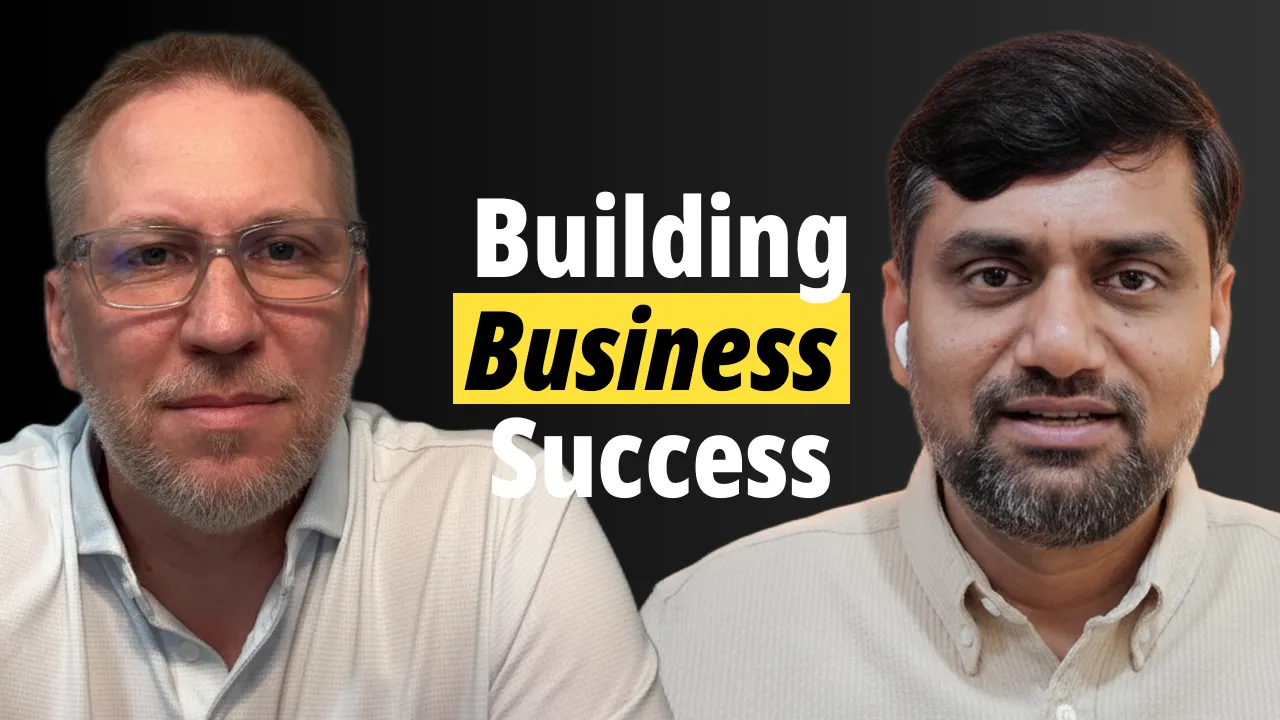
All right, welcome to the sam's podcast. I'm Sam, a serial entrepreneur, marketer and two-time founding director. Currently, I am building a Middleware, which is an end-to-end observability platform. In this podcast series, I interview world-class entrepreneurs, leaders, and founders to learn about their experiences building and growing businesses.
In this podcast episode, I interview Brian Aagaard, founder of Cooperhawk Business Brokerage. They discuss Brian's journey in the business brokerage world, the importance of building relationships with small business owners, and the strategies for adapting to market changes, especially in the wake of the pandemic.
Brian shares insights on utilizing AI in business operations, the challenges faced by small businesses, and effective marketing strategies. He emphasizes the need for planning, consistency, and tenacity in achieving success in entrepreneurship.
Takeaways
- Building relationships is crucial for business success.
- Having a clear plan and strategy is essential.
- AI can significantly improve business efficiency.
- Small businesses must adapt to survive market changes.
- Quality and consistency are key to customer retention.
- Marketing strategies should focus on providing value.
- Tenacity is necessary for overcoming business challenges.
- Understanding financials is vital for business owners.
- Networking and connections can lead to new opportunities.
- Continuous learning and adaptation are important for growth.
Here is details of the conversation
Introduction to Brian Aagaard and His Journey
Sam Suthar
Amazing. So Brian, as I already briefed about you, but it would be really great if you could just share how you started your career in the early days.
Brian Aagaard
My name is Brian Aagaard. I've been in the business brokerage world for roughly 10 years now. started with a prominent company in Minnesota, and then I've been between Arizona and Minnesota. So I branched out on my own as of recent here and started Cooper Hawk business brokerage. And before that, I was in the medical device healthcare world.
And some, uh, both private and public sectors. And, um, I always wanted to, venture out on my own. I was also in the restaurant, uh, bartending industry for many, many years. I've mentioned this in a few of my previous podcasts, but in that industry, it's all about multitasking. It's about customer service. Um, and it's also for me, what I enjoyed a lot was that you have every walk of life that comes in.
that you have to deal with and that's very similar to business owners. You know, there's all types of business owners on how they run, how they operate, where they might have little areas where they can improve on, where I can help them. ⁓ so even before 10 years ago when I started out in the world of business brokerage, I've been curious and interested in business brokering for probably 10 years before I even started. ⁓
After my runs with the corporate world, I thought it was probably best off and I'm best suited for going out on my own and doing my own thing. So here we are.
Understanding Cooperhawk Business Brokerage
Sam Suthar
Amazing, that's great, that great story. So, what exactly are you doing at Cooper Hawk businesses, and can you tell more about these businesses so my audience can learn about them?
Brian Aagaard
Yeah, so Cooper Hawk Business Brokerage, we're in the business broker majority and our focus is on the main street, small business industry. So usually about, you know, two or 3 million or under. So we have business owners in all sectors, help them to strategize in the advisory role, help them strategize on when they are ready to sell, get them knowledgeable about their financials, know, cashflow, what they need to do and where they could better button up.
They're business for when it comes time to sell. So we, we do free business valuations. So we do, you know, we go through the last three years of financials, P and L's and sheets, and we figure out, you know, kind of where they're at, if they were to go market today. or, know, if they're planning a three to five year, again, exit planning strategy, we help them get ready for when that time comes to sell to maximize, you know, what they're going to net on the sale of their business.
Building Relationships with Small Business Owners
Sam Suthar
Okay, so these kinds of small businesses, you always need to work with them and acquiring customers is always difficult. So, how do you acquire those customers, like small business owners?
Brian Aagaard
Yeah, that's a great question. think that the number one thing, just like anything else in this world, I think the relationship is establishing a relationship is the most important, and it's not easy. There are a lot of people out there doing, know, owners are always getting hit up with, you know, sales pitches and what have you.
So the best thing is having contact with content. Tell people, give them something, not just call and say, hey, here's what I do. Are you looking to, are you looking to sell now? You know, I don't think that's the right approach for small business owners. It's all about exit planning. Eventually, someday they're going to do a succession planning of some sort, you know, whether it's an employee, family, or an outside buyer. And it's just teaching them about how to prepare for when that day comes. It's going to come. We don't live forever. don't.
Operate a business forever. So if they're looking to not just completely close the doors, that's where we can help them. So it's to your question, it's all about building a relationship, building rapport, you know, having that trust established. You know, that's a, that's the biggest thing. So a lot of those times, you know, if there's high turnover or burnout in certain industries, you know, a lot of times it's just, it's about consistency.
In quality, and that's what should be the focus. That's my focus. That's Cooper Hawk Business Brokers' focus, for sure. It's just quality and consistency and building that trust. So people know what they're going to get, every time they call in or email or text or whatever it is, it's consistent across the board, make them feel comfortable. Let them know they can trust us, and then go from there. So that's how you do it. It's a long courtship.
It can be quick when someone calls in, and they want to be done for whatever reason, whether it's burnout or health or whatever else, it can be very, very brief and very quick to get to market. But a lot of these times it's about building a solid relationship with these business owners.
Adapting to Market Changes: Pre and Post-Pandemic
Sam Suthar
Okay, yeah, I think building a network as well as the connection is really important. Good, and I understand that small businesses, especially these main industry businesses, went through a lot of ups and downs, right, in the last two decades. So, if you just break down before the pandemic and post-pandemic, how this business evolved itself? Even like with the growth of e-commerce and quick commerce, how businesses are surviving themselves.
Brian Aagaard
Yeah, I think business owners who have a plan and a strategy, mean, the biggest thing I can suggest and convey is that you got to have a plan. You got to have a plan. You got to have a strategy. No one planned for 2020, 2021, 2022. Some businesses thrived, and some were really deeply impacted and had unfortunately closed their doors.
And that's from the business owner all the way to the landlords who weren't getting rent because there was no rent coming in. There was no, your revenue was tenants coming in. So, you know, some of those unforeseen circumstances, you can't plan for it and it's going to be a problem, but the, got to be tenacious. You've got to be, again, have a plan, bounce back, be able to adapt. ⁓ Some businesses, some industries are just going to be impacted much harsher than others.
And I think that's just comes down again to having a strategy, having a, a view, a vision and going after that, whatever it is, you have to roll with the punches. For example, like even, you know, AI and that stuff. Now, a lot of people are, are afraid of AI. It can do a lot of great things for business owners. So, you know, I don't think it's a matter of going up and down a lot.
Think of an owner who has a plan, a strategy, consultants, and advisors, an extension of their team. I think they can make it work and be successful year after year. You know, even with a lot of them, they have growth, continued growth. So that's the biggest thing for a business owner, just to have a vision, have a plan.
The Role of AI in Business Automation
Sam Suthar
Great, as you mentioned that, know, AI definitely plays a very important role. So how do you use AI to automate your businesses, as well as help customers automate their businesses?
Brian Aagaard
I mean, for their business, mean, there's a lot of different AI companies, Sam, as you're well aware, out there. I mean, there are a lot of them out there pushing their niche or their market. So it's just a matter of getting acclimated to AI first and figuring out what you're trying to accomplish with it. Cause some of these niche AI companies are going to be able to better fit what you're trying to accomplish. So it's about learning the AI. How do I help the business owners?
You know, I try to find and look for what AI companies are doing very well in their industry, in their niche. Ask what they're using. Just introduce them to it if they're not already going at it. Introduce them to some of the options they have out there. And that's really as simple as it is because you can't push it on people. You've got to just educate, right? Again, I'm in an advisory role. So it's about suggestions and learning to, you know,
Adapt by helping them to adapt or learn to adapt to what the changes are. They're going to be coming up. How do I utilize it? Mean, you can do financial analysis. can do email responses. It can help to make your day way more efficient in a lot of ways. I use it in many different areas. AI is not perfect. So you always have to go back and make sure everything that's going out is, is accurate and to your, to your standards.
AI just continues to get better and better with each day that it's being used. So I use it in a lot of different areas. And again, I think most business owners are turning to that point because they realize the efficiencies. Once that fear, they overcome that fear, they're able to start utilizing it.
Competitive Guide to Win Over Competition
Sam Suthar
Yeah, that's amazing. I see small business owners and big players; they've already started. Elon Musk and Anthropic's CEO mentioned that by 2027, almost everything will be done by AI. And I think that's definitely there. But then
It doesn't mean human intervention isn't required. It always needed to fix certain issues or maybe just make more corrections to what AI is doing.
So Brian, I notice that small businesses start, and sometimes they just close because they can't scale. There could be a number of factors. There could be an economic factor. local environment factors, as well as financial issues.
Even recently, I have seen a report suggesting that their confidence in doing business is declining. And even the revenue and profit are declining because they are not able to cover living expenses, as well as the rent and everything.
Since you already know that you're working with these people, how can they survive with these big wallets, backchains, and an online giant? And what are your strategies to survive back?
Brian Aagaard
It's about being tenacious and adaptability. think it just keeps going back to that, right? If you don't have a plan, if you fail the plan, you plan to fail, right? That, that, that line is, a, is a great line to use. You've got to have a strategy, you've got to have a plan. Everybody wants to be their own business owner or not, say, but a lot of people want to be their own boss.
It's a very attractive thought, but simply a lot of people don't have the ability or know how to accomplish it. There's a lot involved with that, right? You sometimes go out on a limb and stuff, and it becomes a good thought, a good. A motivator, and then they go out, and they start a business, and they realize pretty quickly there's a lot involved. There is the financial side of things. Not having a plan, they're not having a, you know, what's the future hold within that industry?
You know, there are just a lot of factors. So I think, you know, you have to have something more than just an idea, have to have the ability to plan, have to be able to execute, and then you have to have consistency. Quality's got to be there. All these factors come into play when you start something. Just have, have your, have a plan, have a vision, have a strategy, and be able to execute it. Make sure you have the financing in place.
If you're going at it without planning, you're going to have a really tough time, and, like, to your point, probably close the doors and not make it, unfortunately. So, plan. Strategy execution and then consistency, I think, are some pretty big pointers on what you need to do. and then have the finances in place as well.
Challenges Faced by Small Businesses
Sam Suthar
That's interesting. Of course, like any proper plan, execution is important because often people start by just looking at others. Let's say if you are starting a small food chain or food businesses, just look at a few others who already been successful and you start without a background.
I think background is very important when it comes to doing the local businesses, right? And if you are not, it's not getting the traction, so it's definitely always challenging. Cool, great.
What are the common challenges that you notice the main street businesses faces in nowadays?
Brian Aagaard
Obviously, a big one always with a lot of them is just employees, right? Employees come and go, keeping employees, happy. That's a big one. Another thing is, is I would say technology and just being able to stay on top of technology, the competition. A lot of people like making that, making money, obviously they want to have cashflow coming in.
And it's easy to spend it, but I think you have to set aside and allocate money for technology and growth in a lot of ways, whether it's online marketing, social media marketing, having a digital marketing team or a PR company, depending on what you're doing and trying to accomplish, depending on what industry you're in, I think you have to start allocating some of that, some of that, the money you have coming in to these areas so you can continue to grow and have success.
You've got to be able to play in the sandbox with the other people. You're going to be, you're going to be having a tougher time.
Marketing Strategies for Business Growth
Sam Suthar
My next question is: Affording all activities will always be challenging for anyone. So, what's your take on that? Should they always rely on third-party agencies or build their own team that can just work for them?
Brian Aagaard
Yeah. The third parties, I mean, I think everyone's using the third parties, no matter what you're using digital marketing PR for the most part. think everyone's using third parties to be an extension of their team. And if you can't afford, you know, some of the digital marketing PR, Google paid ads, what's it come down to being tenacious, being able to bootstrap and work hard and do quality with the consistency.
That's the most basic thing you can do as a business owner. that have that? How do you differentiate yourself from the others? Are you the best? What makes people want to come back to you? What makes people give you the good reviews online that makes people look at your business? All these factors come into play.
So if you can't do the know, the forwarding of all the marketing companies and the teams out there, the extensions of the team, then it comes down to quality, inconsistency, and being tenacious. You gotta have a work ethic. ⁓ Being a business owner is not easy. It's not just a, you know, set it up and let everyone do the work. That's not how it works. Not in this space generally. Those are the key components, Sam, on how to get it out there and how to help them get to the next point.
Personal Insights and Inspirations
Sam Suthar
Yeah, that's really good. A person who admires you the most, any person in the world.
Brian Aagaard
I think I admire a lot of people, the most, obviously, you have your parents, right? The most influential people in your life or your, your parents generally are your parents. But I admire people who are tenacious. I admired a lot of people on a, on a pretty regular basis, Sam, on these business owners, what they've accomplished, what they do. They've raised families based on the company they built, right? They put kids through college or just were able to, you know, pay off a house, car, right?
They've succeeded and they've, and they've tasted success. So who do I admire? Obviously, parents are huge on the list, but there's a host of other people who provide stuff on a different level. that I admire a lot, in a lot of different facets and in sections of life. So, that list is quite extensive.
Sam Suthar
Yeah, of course, that would be like depend on the scenario, depending on the tasks, depend on the industries. We always have different people to admire.
And what tools and frameworks do you use to nurture people in your team?
Brian Aagaard
On my team, try to get access. Again, the financial part comes into play. Try to give them everything they need to be successful. I didn't get here on my own. I could go on with a list of people who have helped me become who I am today. again, both family and friends and business. so you you get nuggets, you get the most you can, whatever I've learned in the past and whatever I continue to learn about my industry.
Teams, what's needed, and you give them the tools they need to go out there and succeed, just like I was given by numerous people in the past. Right? So you give people everything they need to go be successful. The goal is always obviously to stay ahead of the competition. That's a forever battle. I won't call it a battle, but it's a lifelong goal. You got to be ahead of the competition. All right? That's what we're here for. Competition's good.
Um, but we also all want to be, you know, the best or the one first one getting a phone call. If someone's looking to sell or start looking for advice on exit planning. So, um, that's what I, that's my goal. And in my team, we're giving them everything they need to make their job, uh, as efficient as possible, to the point where they can have, you know, life outside of work, um, easy, easy navigation throughout the day with tools and software processes, right? All the same stuff that a business owner needs. Those are my goals.
Sam Suthar
Amazing, that's a clear goal. If you get a chance to have dinner with a business tycoon, maybe a big one, who would be that?
Brian Aagaard
Uh, on a big business owner, they've already made it. So, I mean, I, there's, I can get a lot of nuggets of information from them, but for me at this stage of my life and career, um, my goal is to meet with, with business owners, right? I know what I'm doing. Um, I feel confident in what I do and bring to the table, um, and who I am as a, as a person on the, on the trust level as well. So for me, who I want to meet with would be the business owners. Um, the big tycoons, you know, I don't.
I don't get starstruck. Again, the admiration's there for people who are building things and the creations of what they're doing out there. You mentioned Musk, there's Bezos, there's a host of other people that are huge business folks. for me, it's the business owner, right? That's who I like to meet with.
Sam Suthar
Amazing, that's what you do when you are down or upset?
Like, you know, even in businesses, we often see a lot of downtime. and even be upset about a lot of things, like financial goals or maybe performance or anything else. So what do you do to overcome these challenges?
Brian Aagaard
When I have challenges, what do I do? You, you, you, you suck it up, Sam, you suck it up and keep moving. Challenges are going to happen every single day. When you're a business owner, whether you're in an advisory role or a sales role, you get told no a lot, right? You have to have tough skin, thick skin. You have to be able to roll. There's going to be someone else out there who can utilize it. Even the people that say no, sometimes Sam comes back later on and be like, Hey, I need your help. You just, you keep moving. You know, it's,
It's not all puppies and rainbows out here. So you gotta just keep on, you gotta keep on moving. Consistency, right? Consistency, keep moving. So there's someone else who needs help. Keep the phone calls going, keep the marketing going, keep the emails going. That's it. That's how you win people over.
Sam Suthar
Good, and I just have the opposite question now: how do you celebrate your success when the goal is accomplished? ⁓
Brian Aagaard
I'll figure that out once I retire. For now, you're only as good as your last deal in this. In any sales job, I tell people you're only as good as your last deal. So once it's over, the success is very short-lived. That's it. Where's the next person you can help out? That's the way I view it. I'll let you know when to hit retirement, what that feeling is really like.
Sam Suthar
Okay? And what do you do when you are not at work? In general.
Brian Aagaard
Not at work. yeah. I'm a big music, a big fan of music. Listen to everything. I tell people I'm a rock to Bach. I listen to a wide variety of music. I like hiking, mountain biking, and sports. big. I love sports. Yeah. I mean, that's a bulk of what I do. Hang out with family and friends. You know, I'm,
Sam Suthar
What sort of sports do you like?
Brian AagaardI was born and raised a hockey player growing up. So I love hockey. ⁓ it's my favorite sport. I love everything about hockey. But I like football. like, ⁓ you know, I like a lot of sports, baseball. watched my niece, nephews, play basketball, you know, hockey, baseball, volleyball. So I watch a little bit of everything, Sam. It's, it's when you have.
When you have teenagers in the family and stuff, and they're involved in sports, there are a lot of activities you have to keep up with. So you've got to be the good uncle. So that's what we're doing.
Sam Suthar
Yeah, of course. Do you read books as well?
Brian Aagaard
I read some books. Work has been pretty busy. Starting a new business has been quite busy. So that's my focus is really on work. Educating myself more within the industry, keeping up to date with a lot of the things that are going on. So that's a bulk of my stuff that I'm paying attention to and focusing on right now.
Sam Suthar
Any books, especially any books for small businesses, business owners, that you recommend.
Brian Aagaard
Uh, you know, I'd say good. I don't have any for small business owners. The ones I'm reading are for business brokerage, uh, specifically. Um, there are a lot of great books out there. So, um, there's, there's a lot of great, um, you know, business brokers that have been around for a long time that have put some stuff out there. Um, I would just say go, go and research.
There's a, there's a ton of details information and resources and material out there for business owners to figure out how to get better, do better. I would just say resources, they're out there. You can Google almost anything or anything's at your fingertips if you want it. So if you want it, I would just say be paying attention to what's going on out there and get as many resources as you can.
Sam Suthar
Okay, and if somebody wanted to reach out to you, what would be the best way to connect?
Brian Aagaard
You can connect with me via email. It's Brian, B-R-I-A-N at cooperhawkbrokers.com. Or you can reach me on my cell phone, 952-239-4234.
Sam Suthar
Amazing. So that's all about this podcast, and thanks for joining us today, Brian. Really nice talking to you.
Brian Aagaard
Thank you, Sam. I appreciate the time.
Sam Suthar
Thank you.